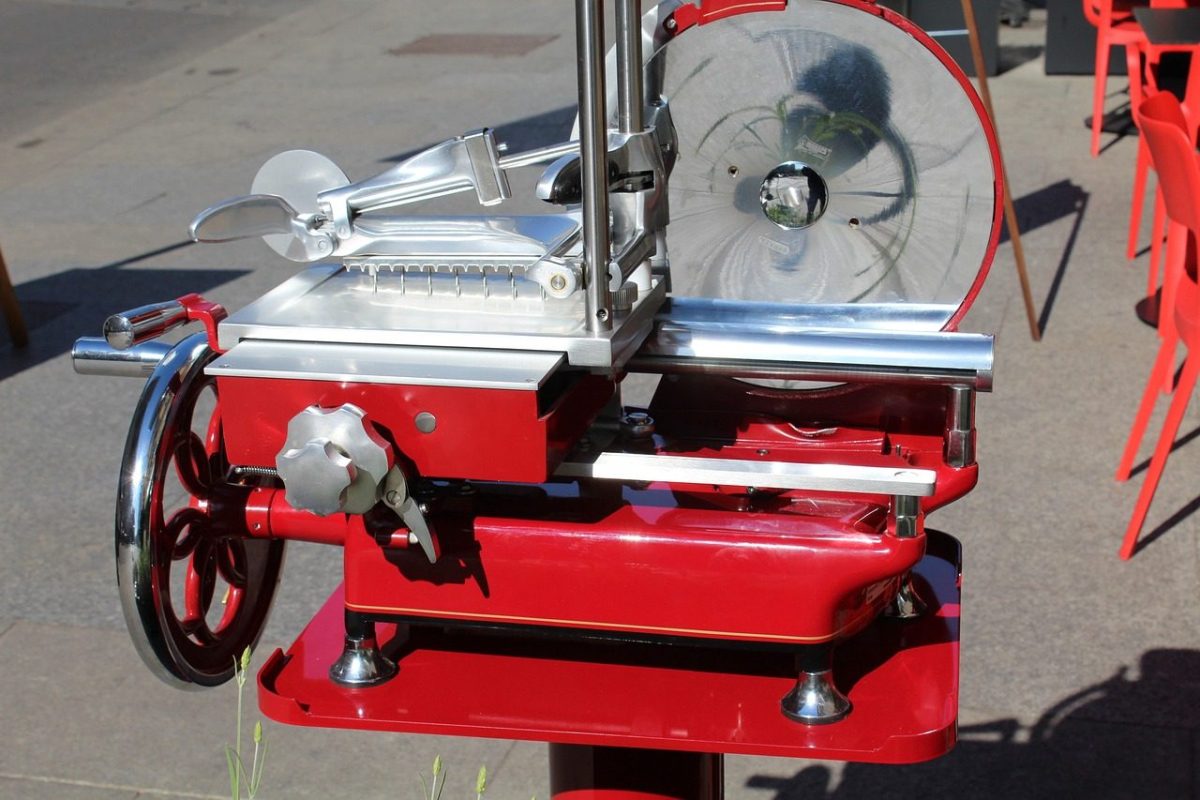
What blade diameter do you need?
Blade diameter sets the widest slice a machine can take in one pass and, and, in practice, the largest piece of sausage or cheese you can lay flat on the carriage. A 250 mm blade handles logs up to roughly 200 mm across, a 300 mm blade covers most catering packs, and 350 mm and above are built for whole ham and block cheese.
The diameter also changes how the blade meets the product. A larger blade turns at the same motor speed but with a longer cutting edge, so the slice stays cleaner on dense cheese and on dry-cured sausage that tends to crumble. Smaller blades suit sliced meats, salami and soft cheese, where the log is narrow and the counter space is tight.
- A 220-250 mm blade fits a small cafe slicing salami and sandwich cheese to order.
- A 250-300 mm blade is the working size for most restaurant prep kitchens.
- A 300-350 mm blade covers deli counters and catering units cutting whole logs.
- Blades above 350 mm suit block cheese and whole ham, and the machine gets bigger and heavier to match.
Measure the widest product you actually buy before you choose. If your supplier delivers 100 mm salami, a 250 mm blade is enough and leaves more clear counter for the rest of prep.
How much motor power is enough?
Match motor power to the hardest product you slice and to how many hours a day the machine runs. For soft sausage and semi-hard cheese on a gravity-feed slicer, 0,25-0,37 kW (roughly 0,3-0,5 hp) is usually enough. Hard cheese such as Parmesan, dry-cured sausage and any belt-driven model that cuts continuously need 0,5-0,75 kW, and busy deli counters often run 0,75-1,1 kW.
The peak wattage on the label tells you little. What cuts dense product cleanly is torque at the blade, and a geared motor of modest power with the right blade speed beats a high-wattage direct-drive unit that stalls and smears fat. Duty cycle matters more still: a motor rated for 30 minutes on and 30 off will overheat in a counter that slices all day. Choose a continuous-duty or 100% duty rating if the slicer runs through service.
- Check the duty cycle, not just the wattage, on the data plate.
- A geared transmission gives more usable torque at lower blade speed.
- Belt-driven slicers need extra power to drive the belt as well as the blade.
- Hard cheese and dry sausage are the true test of a motor.
- Thermal overload protection stops a stalled blade from burning out the motor.
Which safety features are non-negotiable?
A blade guard that covers the exposed part of the disc is the first thing to check. On a gravity slicer the guard should stay in place through the full travel of the carriage, not just at rest. The product holder must grip sausage and cheese firmly without your hand entering the cutting zone, and it should slide freely rather than jam halfway.
The last-slice device keeps the final piece from tipping into the blade, which matters most with soft cheese and thin-sliced sausage. Look for a switch placed where you can reach it without leaning over the blade, and a blade lock or tool that holds the disc during removal. Ask for the manual and confirm the machine carries a CE mark.
- The blade guard covers the disc at every carriage position.
- The product holder grips firmly and moves without sticking.
- The last-slice device is present and undamaged.
- The on-off switch sits on the operator side, clear of the blade.
- A blade lock or removal tool comes with the machine.
- The CE mark and manual are included on delivery.
How easy is the machine to clean?
Commercial slicers are cleaned at least once per shift, and the machine you cannot strip down in two minutes will stay dirty. Look for a blade assembly that lifts off without tools: a single release catch or a quarter-turn lock beats three separate screws every time. Check that the blade guard, product table and meat grip all come away by hand, and that no part needs a screwdriver to reach the food contact zone.
Run a finger along the seams before you buy. Fat and cheese residue collect in the gap between the blade and its housing, behind the thickness plate and under the product table rails. A smooth, continuous surface with few joints cleans in minutes, while deep recesses and exposed screw heads hold debris no brush will reach.
- Blade assembly releases by hand, with no tools and no loose fasteners.
- Food contact parts are 304 stainless steel, not painted steel or aluminium.
- Surfaces are smooth and brushed or polished, with no rough welds or pits.
- Thickness plate and blade guard come off as separate, washable pieces.
- No open screw holes or recesses where fat can pool.
The steel grade matters as much as the shape. Grade 304 stainless steel resists the acids in sausage and the salt in cheese, while lower grades pit and roughen over time, and a roughened surface traps bacteria. A polished or fine-brushed finish wipes clean, but heavy grinding marks give residue somewhere to sit.
Gravity or belt-driven: which feed suits your counter?
On a gravity slicer the carriage falls through the product under its own weight, and the operator loads the food, sets the thickness and guides the carriage by hand. Belt-driven models pull the carriage along a track at a steady speed, which keeps slice thickness even across a whole ham or block of cheese and takes the strain off the wrist during long prep sessions.
Gravity units have the smaller footprint and no drive belt to tension or replace, which suits a café counter where you slice a few kilograms a day. Belt-driven machines are heavier and need clearance behind the carriage for the full travel, but they hold up better in a hotel kitchen running trays of cold cuts for hours.
- Measure the counter depth plus the carriage travel before you commit to a belt-driven model.
- Gravity feed gives direct feel for firm cheese and dry sausage, but slice thickness depends on the operator.
- Belt drive keeps cuts uniform when a less experienced cook takes over the station.
- Check that the belt and track are reachable for cleaning without tools.
- For volumes above a few kilograms a day, the steadier feed usually wins on consistency.
What should you check before you buy?
Measure the counter space first, including the clearance the carriage needs to slide and the room the fence leaves for long products. A slicer that fits the footprint but not the stroke will not work. Confirm the supply voltage and breaker rating on site against the machine's plate, and check that the counter can carry the weight of a gravity unit.
Ask the supplier two direct questions: are spare blades and the blade guard held in stock, and who services the machine locally. A slicer with no blade supply or local service becomes scrap the first time the edge dulls.
- Test-cut your own sausage and cheese, chilled to service temperature, before you pay.
- Check that the blade runs true, with no wobble or vibration at full speed.
- Confirm the carriage glides smoothly through the full stroke.
- Ask for the blade diameter and motor rating in writing.
- Verify the guard and last-slice device work as intended.
FAQ
Can one slicer handle both sausage and hard cheese?
Yes, if the blade and motor are sized for the harder product. Hard cheese puts more load on the blade than cooked sausage, so pick a machine rated for cheese and it will handle sausage without strain.
How thick can a commercial slicer cut?
Most carriage slicers adjust from paper-thin slices up to roughly 12-15 mm, which covers cold cuts, sandwich cheese and thicker deli portions. Check the adjustment range on the model you are buying, since cheaper units often stop short of the thicker end.
Do I need a separate slicer for cheese?
Not usually. A single machine with a large enough blade and enough torque will cut both, provided you clean the blade between products to avoid fat buildup and flavor transfer.
How often should the blade be sharpened or replaced?
Sharpen or replace the blade when cuts start tearing instead of slicing cleanly, which in daily service typically means checking it every few months. Keep a spare blade so the machine stays in use during servicing.
