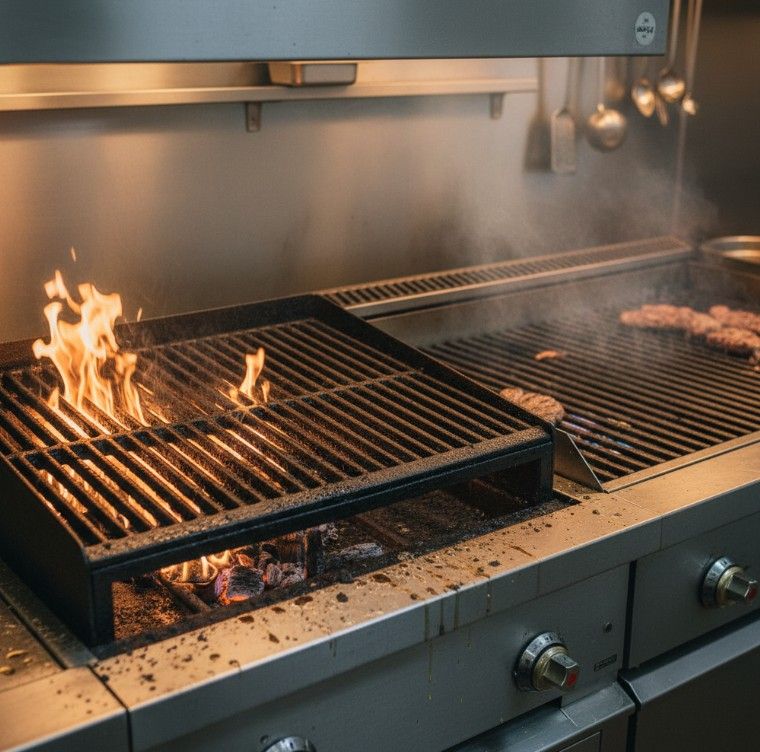
Picking the wrong kitchen equipment costs restaurants thousands in wasted money and lost efficiency. Walk into any professional kitchen and you’ll see charbroilers and grills doing completely different jobs, yet plenty of new restaurant owners treat them like interchangeable equipment. They’re not, and understanding why matters for your kitchen’s bottom line.
How Charbroilers Actually Work
Charbroilers blast food with direct heat from gas burners positioned directly beneath heavy-duty grates. The intensity separates them from everything else in your kitchen. Most commercial charbroilers hit 800-1000°F within 10-15 minutes, creating the aggressive sear marks customers associate with premium steakhouses.
The construction tells you everything about their purpose. Heavy stainless steel bodies house burners putting out 80,000-120,000 BTU per hour. Compare that to residential grills maxing out around 40,000 BTU and you understand the difference immediately.
Professional char grills feature cast iron or stainless grates thick enough to retain heat when cold food hits them, individual burner controls letting you run different temperature zones simultaneously, and grease management systems channeling drippings away from flames.
You’re looking at $2,000-$8,000 for a basic 24-36 inch charbroiler, with heavy-duty models running $10,000-$25,000.
Standard Commercial Grills Serve Different Purposes
Regular commercial gas grills operate at lower temperatures, typically 400-600°F, distributing heat more evenly across the cooking surface. This makes them better for delicate proteins that would char too aggressively under a broiler’s intensity.
Standard grills prioritize versatility over raw power, using 30,000-60,000 BTU burners that provide gentler, more controlled cooking. Your kitchen staff can handle chicken breasts, fish fillets, and vegetables without constant attention to prevent burning.
Price points reflect the difference in construction and capability. Decent commercial grills start around $800-$1,500, with professional-grade units reaching $3,000-$5,000. You’re saving 40-60% on initial equipment costs compared to charbroilers.
Performance Differences That Actually Matter
Heat output and recovery speed separate these two equipment types more than anything else. Drop six cold ribeyes on a charbroiler and the surface temperature might dip 50-100°F before recovering in 2-3 minutes. The same load on a standard grill causes a 150-200°F drop, taking 5-7 minutes to climb back.
Charbroilers cook a 1-inch steak in 6-8 minutes with proper crust development. Standard grills need 10-12 minutes for similar results with less dramatic searing. Energy costs run $1.50-$2.50 per hour for charbroilers versus $0.75-$1.25 for standard grills.
Expected lifespan depends heavily on usage volume and maintenance quality. High-end charbroilers from manufacturers like Wolf or Vulcan last 10-15 years in busy restaurants. Budget models might give you 5-8 years. Standard commercial grills from reputable brands also hit 10+ years with proper care.
Making the Right Equipment Decision
Your menu determines everything. High-volume steakhouses absolutely need charbroilers because customers expect specific char marks and crust development on premium beef. Casual dining restaurants serving varied menus often choose standard grills for their flexibility.
Every jurisdiction requires Type I hood systems for charbroilers, adding $15,000-$50,000 to installation costs. Standard grills sometimes qualify for cheaper Type II hoods.
Stop thinking about which equipment is “better” and start asking which equipment matches your menu, volume, space, and budget. A $6,000 charbroiler sitting idle because your menu doesn’t need it wastes more money than a $2,000 grill working at full capacity.