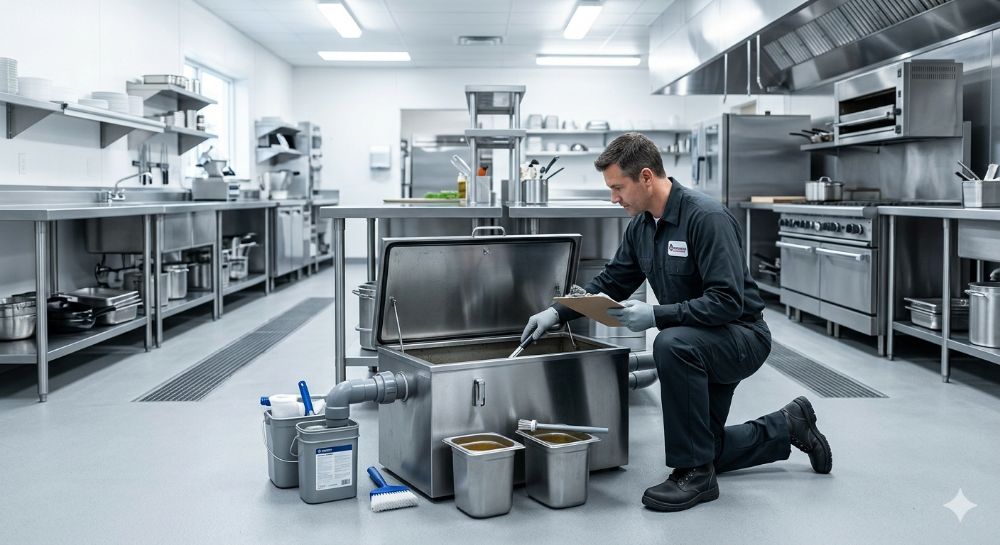
Grease traps should be cleaned every 1–3 months for restaurants, quarterly for commercial kitchens, and 2–4 times per year for small businesses. Frequency depends on usage volume, grease production, and local health department regulations. Regular cleaning prevents blockages that cause equipment failure, staff safety issues, and costly fines – health inspectors cite businesses for inadequate grease trap maintenance.
Grease Trap Cleaning Frequency
→ Restaurants: Every 1–3 months (heavy daily grease production)
→ Commercial kitchens: Every 3 months (regulated usage)
→ Small food businesses: Every 2–4 months (moderate usage)
→ Residential: 1–2 times per year (minimal usage)
Frequency depends on grease production volume plus trap capacity. Neglect causes blockages, equipment failure, and health violations.
How Often Should You Clean a Grease Trap?
The answer to grease trap cleaning frequency varies by business type and daily usage. A restaurant serving 200+ meals daily needs monthly cleaning. A small café serving 50 meals daily needs quarterly cleaning. Commercial kitchens (catering, hospitals) typically require quarterly cleaning unless volume is exceptionally high.
Frequency by business type:
| Business Type | Frequency | Reason |
| Restaurant | Monthly (1–3 months) | High daily grease output |
| Commercial kitchen | Quarterly (90 days) | Medium grease production |
| Small food business | Every 2–4 months | Lower daily volume |
| Residential | 1–2 per year | Minimal grease use |
The primary factor is daily meal covers multiplied by average grease per meal. A 100-seat restaurant serving 200 covers daily produces approximately 5,000 lbs of grease monthly – requiring monthly cleaning. A 500-person corporate cafeteria produces 2,000 lbs monthly – requiring quarterly cleaning.
Understanding commercial kitchen safety standards helps establish proper maintenance routines aligned with health code requirements.
Why Does Grease Trap Cleaning Frequency Matter?
Neglecting grease trap cleaning frequency creates three critical failures: blockages, equipment damage, and health code violations.
When grease exceeds trap capacity, it backs up into drain lines. Blocked drains force water and grease to overflow into food prep areas – creating cross-contamination hazards. Staff slip on wet floors, food touches contaminated surfaces, and customers face foodborne illness risk.
The financial impact is severe. A clogged drain repair costs $500–$2,000. Equipment replacement costs $5,000–$50,000. Health department fines for maintenance violations range $1,000–$10,000. A business losing hours due to drain backup loses $500–$2,000 daily in revenue.
Real impact: Skipping one scheduled cleaning costs $20,000–$70,000 in emergency repairs, fines, and lost revenue. Scheduled cleaning costs $400–$800.
What Happens If You Miss Scheduled Cleaning?
Within 3–4 weeks of missing a cleaning date, the trap reaches 75% capacity. Drain flow slows. Grease coats interior pipes. Staff notices foul odors. Water accumulates on floors, making food prep impossible.
Health inspectors arrive (called by staff or neighbors). Violations are issued. Mandatory closure occurs until cleaning is completed – forcing business closure during peak season. Food safety best practices for your restaurant kitchen emphasize grease trap maintenance as a non-negotiable safety requirement.
FAQ:
Q: Can I determine frequency by visual inspection?
A: No. Frequency depends on volume calculations, not appearance. Never wait until the trap “looks full” – use a documented schedule based on business volume and local requirements.
Q: What’s the difference between cleaning and pumping?
A: Cleaning removes buildup inside the trap. Pumping removes accumulated grease. Restaurants need both – monthly cleaning plus quarterly pumping.
Key Takeaway
Grease trap cleaning frequency is not optional – it’s a regulatory requirement. Document every cleaning. Calculate frequency based on volume, not appearance. Scheduled maintenance costs $400–$800. Neglect costs $20,000–$70,000.
