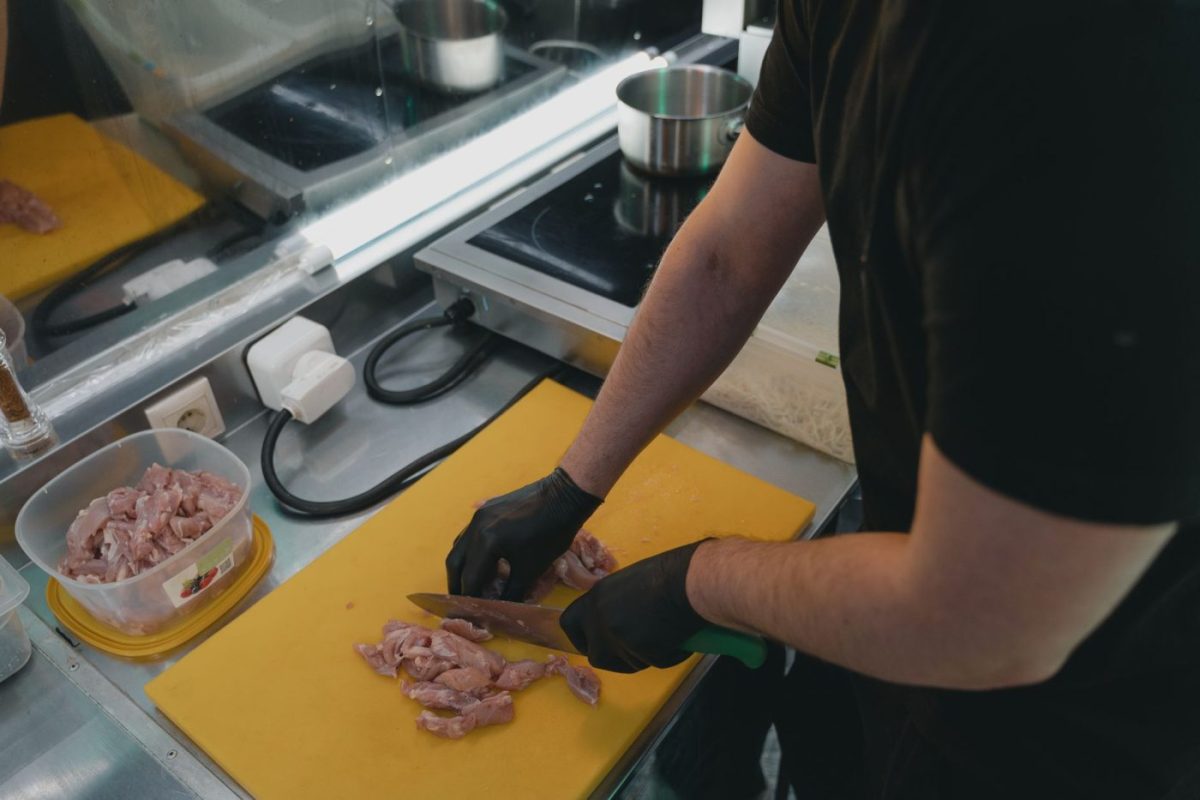
How many kilograms per hour does your canteen actually process?
A small canteen serving 50 to 80 covers at lunch often needs 15 to 25 kg of minced meat in a single hour. A larger site with 200 covers can push that figure past 40 kg. The number that matters is the peak, not the daily average, because the grinder must keep up when every order hits the pass at once.
Rated output on a spec sheet is measured under ideal conditions with lean beef and a medium plate. In real use, partially frozen meat, sinew and a finer plate all slow the machine down. You should pick a model whose stated capacity is at least 30% above your busiest hour. If you calculate a peak of 30 kg, choose a grinder rated for 40 kg/h or more. This headroom stops the motor running flat out for long stretches, which overheats the meat and shortens gearbox life.
What grinding plate diameter fits a canteen workload?
The plate diameter limits how much meat the grinder can process per hour. A larger plate allows a wider auger and a bigger feed opening, so you push through more product per minute without forcing it. For a canteen serving 100 to 300 meals a day, the plate size directly determines whether the machine works at a steady pace or becomes a bottleneck during prep.
Commercial models with a #12 plate (roughly 70 mm diameter) handle 80 to 120 kg/h when paired with a 0.75 kW motor. Stepping up to a #22 plate (82 mm) gives you 200 to 300 kg/h on a 1.1 kW motor, enough for most mid-sized canteens. A #32 plate (98 mm) pushes output past 400 kg/h with a 1.5 to 2.2 kW motor, while larger #42 or #52 plates go beyond 600 kg/h for central kitchens supplying multiple outlets.
- A #12 plate suits a small canteen making a single batch of cutlets or meatballs once a day.
- A #22 plate covers a 200-seat canteen that processes 40 to 60 kg of meat in a morning shift.
- A #32 plate handles continuous grinding for a 400-seat canteen or a kitchen that also preps fillings for dumplings and pies.
- A #42 or #52 plate belongs in a production kitchen where the grinder runs for hours without stopping.
- Undersizing the plate forces the motor to work harder, heats the meat and shortens the machine’s life.
- Oversizing adds upfront cost and takes up counter space without giving you a practical speed benefit.
Why does the auger material decide how long the machine lasts?
The auger, a spiral shaft, pushes meat toward the blade and plate. It takes constant friction and pressure, so its material directly controls wear rate and hygiene risk. In a canteen running the machine for hours at a stretch, a poor auger material means early failure or a health inspector's finding.
Cast iron augers hold up well under heavy loads and resist abrasion from sinew and small bone fragments. The trade-off is weight and rust sensitivity. A cast iron auger must be dried immediately after washing or it pits and flakes, creating crevices where bacteria hide. Stainless steel augers solve the rust problem and are easier to sanitise, but softer grades of stainless can gall against the housing if lubrication is skipped. Plastic augers appear only in light-duty domestic machines. They wear quickly, can crack under the torque a canteen grinder produces, and are not repairable once damaged.
- Cast iron handles grit and sinew but demands strict drying after every wash.
- Stainless steel resists corrosion and simplifies sanitation, provided the grade is hardened.
- Plastic augers belong in household units and have no place in a canteen.
- A worn auger increases the gap to the housing, dropping output and overheating the motor.
- Replacing a cast iron or stainless auger costs far less than replacing a seized gearbox.
Single-phase or three-phase motor for a canteen?
A single-phase 220V grinder handles up to about 150 kg/h and plugs into a standard outlet, which works for a small canteen serving 50 to 80 covers a day. You need a dedicated 16A circuit and a C-curve breaker to handle the starting current without nuisance tripping. If your panel is already near capacity, adding a 2.2 kW motor may require an electrician to pull a new line.
Once you cross the 200 kg/h mark, a three-phase 380V motor becomes the practical choice. The current draw per phase is lower, the motor runs cooler during continuous batches, and the machine tolerates the stop-start rhythm of a busy lunch service without overheating. Three-phase grinders typically start at 3 kW and need a 5-pin CEE socket on a circuit protected by a motor-rated breaker, usually 10A or 16A type D.
Check the supply in your kitchen before you order. Many older canteen buildings have three-phase at the main panel but only single-phase outlets at the prep station. Running a new 5-wire cable across a tiled kitchen is a fixed cost that can make a mid-sized 220V grinder the smarter buy, provided it stays within its duty cycle.
What safety features stop a grinder from burning out?
A thermal overload protector is the first line of defence. When the motor windings reach a preset temperature limit, the protector cuts power before insulation melts or the coil shorts. In a canteen where operators may run batch after batch without pause, this single component often prevents a total motor failure.
The reverse function clears jams without you having to open the grinding head. A momentary reverse switch backs the auger out of a bone fragment or a wad of sinew, then the operator resumes forward grinding. This avoids the prolonged stall current that overheats a motor in seconds.
Automatic shut-off works differently from thermal protection. A timer or a current sensor stops the machine after a set run interval or when resistance spikes above normal load. Together, these three systems keep a grinder running through a lunch rush instead of tripping the main breaker or burning out mid-shift. When comparing models, look for:
- Manual reset thermal overload button on the motor housing, not a self-resetting type that restarts unexpectedly
- Momentary reverse switch that springs back to neutral, preventing accidental continuous reverse operation
- Current-sensing automatic shut-off that reacts to a jam faster than a thermal protector
- Sealed control housing rated IP55 or higher to keep moisture and meat dust off electrical contacts
- Separate circuit breaker at the wall with the correct amperage rating for the motor nameplate load
Household vs commercial meat grinders: where the cost difference goes
A household grinder runs for about 5 to 10 minutes before it needs to rest. Its motor has a short duty cycle, typically 10 to 15 percent, meaning it can grind for one minute out of every seven. Push it longer and the thermal overload trips, or the motor burns out. A commercial machine runs for 30 to 60 minutes straight and handles back-to-back batches all morning.
The gear train tells you the rest of the story. Household models use plastic or sintered metal gears that strip under sustained load. Commercial units use hardened steel gears inside an oil-bath gearbox, a design that runs quieter and lasts for years of daily use. Noise follows the build quality: a plastic transmission whines at 80 to 85 dB, while a gear-driven commercial unit hums at 65 to 70 dB. Your staff will appreciate the difference during a long prep shift.
The cost gap widens most when it comes to serviceability. Parts for a household grinder are often glued or clipped together, so a stripped gear means you throw the whole unit away. A commercial grinder comes apart with basic tools:
- The grinding head unscrews for separate cleaning and inspection.
- Blades and plates are standard diameters and can be sharpened or replaced individually.
- Motor brushes and seals are sold as spare parts with part numbers in the manual.
- A local appliance repair shop can service the gearbox without special training.
You pay more upfront for a commercial grinder, but you get a machine that a technician can rebuild rather than one you toss after a busy season. For a canteen that processes 30 kg or more of meat per day, the repairable design pays for itself within the first two years.
How to keep a canteen meat grinder clean and compliant
A canteen meat grinder handles raw protein daily, so you need a written cleaning schedule. Health inspectors look for documented steps: disassembly, washing, sanitising and drying. The grinder head, plate, knife and auger must be taken apart after each service. Leaving meat residue overnight invites bacterial growth and hardens into a film that is difficult to remove the next morning.
All removable parts should be made from 304-grade stainless steel. This grade resists the pitting and rust that cheaper 201 or 430 grades develop after repeated contact with salt, acidic marinades and chlorine-based sanitisers. Plastic hopper trays and pushers need checking for cracks where food can lodge. Cracks mean replacement, not a patch-up. Fixed body panels and the motor housing get wiped down with a damp cloth and a non-abrasive detergent. Never spray water directly at the motor vents or the switch housing.
A four-step daily routine keeps the machine compliant and extends blade life:
- Unplug the grinder and disassemble the head assembly completely, removing the retaining ring, plate, knife and auger.
- Wash all stainless steel parts in hot water with a food-grade degreaser, then rinse until no soap film remains.
- Immerse parts in a no-rinse sanitiser mixed to the concentration printed on the label, and air-dry on a rack.
- Wipe the auger drive pin and the motor body with a clean, damp cloth, then dry with a disposable towel.
Reassemble only when every component is dry to the touch. A damp plate against a dry knife creates the friction that dulls edges and strains the motor on startup. Keep a spare knife and plate set on the shelf. Rotating them lets you send the dull set for sharpening without stopping production, and the inspector sees you are serious about maintenance.
FAQ
Can I use a heavy-duty household meat grinder in a small canteen?
It will work for a few weeks, then the plastic gears or the undersized motor will fail. Household grinders are built for intermittent use, about 5 to 10 minutes at a time. A canteen needs a machine rated for continuous operation, with metal gears and a duty cycle of at least 30 minutes without a break.
What plate size do I need for 100 kg of meat per day?
A #22 plate, roughly 82 mm in diameter, typically handles 150 to 250 kg per hour. That gives you enough headroom for a 100 kg daily total, even if half of it comes through in a single lunch rush. A #12 plate would struggle and overheat.
Is a stainless steel auger worth the extra cost?
Yes, for a canteen. Stainless steel resists corrosion from salt and acidic marinades, cleans faster and does not shed metal particles the way a worn cast iron auger can. The higher upfront cost is recovered through longer service life and fewer health inspection issues.
How often should I sharpen the blade and replace the plate?
Sharpen the blade every 100 to 150 hours of operation, or sooner if the meat starts to smear instead of cutting cleanly. Replace the plate when the holes show visible rounding or rust pitting. With daily use in a canteen, plan on a new blade and plate set roughly every 6 to 12 months.
