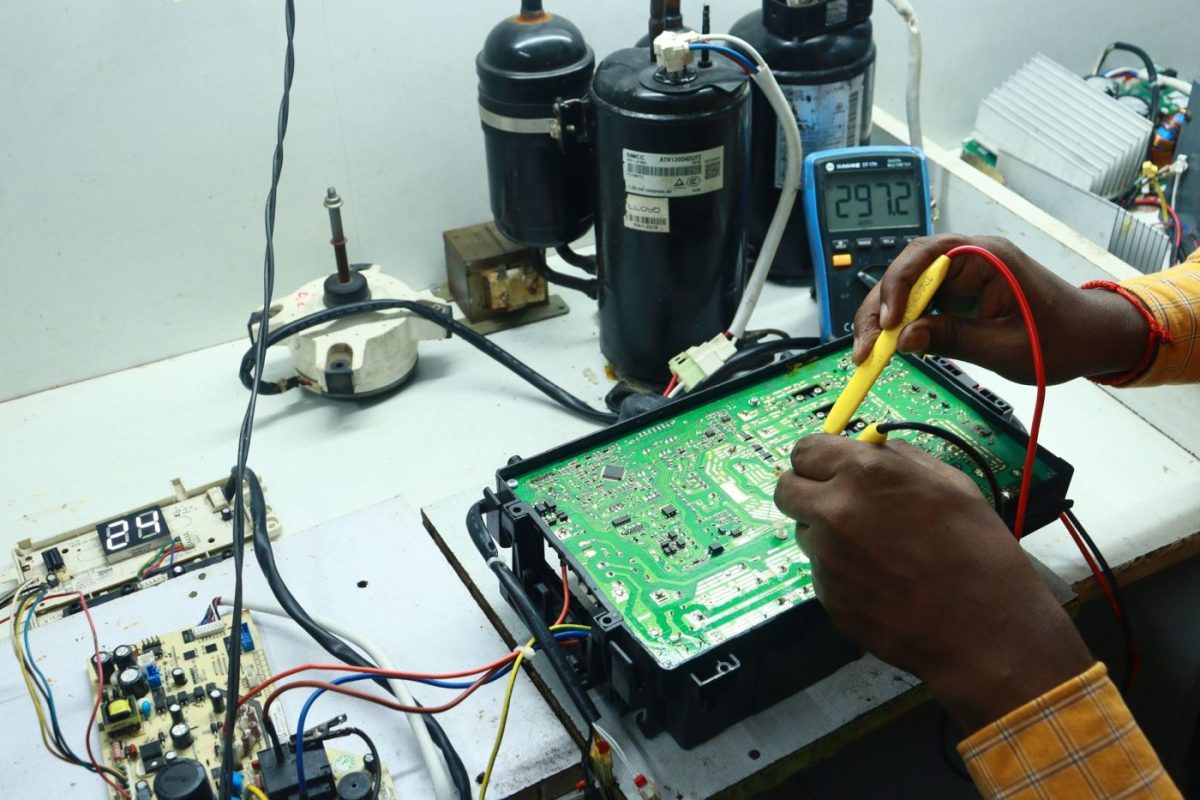
What an oven thermostat actually does
A thermostat is a temperature-activated switch. It senses the heat inside the oven cavity and cycles the heating element on and off to hold a set temperature. When the oven is cold, the thermostat closes the circuit and the element heats up. Once the air reaches the target, the thermostat opens the circuit and the element shuts down. As the oven cools a few degrees, the thermostat closes again and the cycle repeats.
Every mechanical thermostat has a dead band, a built-in temperature range that prevents the element from chattering on and off every second. A swing of 20 to 30 degrees Fahrenheit around the set point is normal in most commercial ovens. You set the dial to 350 °F, the thermostat cuts power at roughly 365 °F and re-energizes the element around 335 °F. A consistent offset of 50 degrees or more is a fault. The oven either runs far too hot or never reaches full temperature, and the thermostat needs recalibration or replacement.
The boiling water test: a quick accuracy check
You can verify thermostat calibration at the boiling point without opening the appliance. Boiling water provides a fixed reference of 212 F (100 C) at sea level, which you compare against the oven’s built-in reading. For every 500 ft of elevation above sea level, water boils roughly 1 F lower, so a kitchen in Denver at 5,280 ft expects a reading around 201 F. Check your local altitude before you start.
Use a digital probe thermometer with a thin tip, rated for at least 300 F. Clip the probe so the tip sits in the center of the oven cavity without touching the racks or walls. Set the thermostat to 212 F and allow the oven to cycle on and off three full times. That cycling stabilizes the air temperature around the set point.
- Fill a small pot halfway with water and bring it to a rolling boil on the stovetop.
- Insert the probe thermometer into the boiling water, keeping the tip off the pot bottom.
- Record the reading once it steadies; this is your true boiling point at your altitude.
- Move the same probe into the preheated oven and wait two minutes for the reading to settle.
- Compare the oven air temperature to your recorded boiling point. A difference of more than 10 F points to a calibration issue.
- Repeat the test with the thermostat set to 350 F if the oven supports it, checking the offset holds consistent.
A thermostat that reads within 5 to 10 F of the boiling point is adequate for most cooking. A larger gap means the sensor or the capillary tube may need adjustment or replacement.
How to use a multimeter to test thermostat continuity
A multimeter confirms whether the electrical contacts inside the thermostat close or stay open. You test for continuity, meaning a complete circuit. The oven must be cold. A warm thermostat that has already tripped will read open even if the part is good, so let the oven sit unused for at least two hours before you begin.
Set the multimeter to the lowest ohms scale, usually 200 Ω. Touch the two probes together. You should hear a beep or see a reading close to zero. That tells you the meter works. Now isolate the thermostat by cutting power to the appliance at the breaker and removing at least one wire from the terminal to avoid reading through the rest of the circuit.
- Press the meter probes firmly against the two thermostat terminals. Polarity does not matter for a continuity check.
- A reading near 0 Ω or a steady beep means the contacts are closed. On a cold oven this is what you expect.
- A reading of OL, infinite resistance or no beep means the circuit is open. On a cold oven the thermostat has failed.
- Turn the temperature dial slowly through its range while watching the meter. The reading should stay closed then open when the dial clicks past the current room temperature.
- If the reading flickers or jumps when you gently tap the thermostat body, the internal contacts are pitted or loose and the part is unreliable.
- Any reading between a few ohms and a few hundred ohms on a cold thermostat suggests high resistance across the contacts, which will cause erratic cycling.
A cold thermostat that reads open or shows unstable resistance needs replacement. The test takes two minutes and costs nothing, but it works only when you follow the cold-oven rule. If the reading is correct and the oven still misbehaves, the problem is elsewhere, likely the sensor or the control board.
Signs your thermostat has failed completely
A thermostat that is merely out of calibration still responds to temperature changes. A dead thermostat stops controlling heat altogether. These three hard failures mean the component needs replacement rather than adjustment.
- The oven stays cold even after 20 minutes and the indicator light never cycles off. Power reaches the selector switch but the thermostat contacts stay open.
- The oven runs continuously and never shuts off the bake element. Surface temperatures climb well past the set point, often exceeding 260°C (500°F) with no cycling.
- The broil and bake elements behave erratically. In some failures the broil element comes on during a bake cycle or both elements fire at once, tripping the breaker.
- You hear no audible click when turning the thermostat knob through the full range. A working thermostat produces a distinct mechanical snap as the contacts open or close.
- The oven heats normally but the indicator light stays dark. This points to a failed switch contact inside the thermostat body rather than a dead element.
Once a thermostat fails mechanically or electrically, recalibration cannot fix it. Continuing to use the oven risks scorched product and a potential fire hazard if the safety limit switch is also compromised.
When to call a technician instead
Stop testing and call a technician if your oven runs on gas with a standing pilot. Disturbing the gas line or thermocouple without proper training can create a leak or extinguish the pilot in a way you cannot safely relight. The same rule applies to any oven where you smell gas during operation, even faintly. Shut off the gas at the appliance valve and ventilate the kitchen before making the call.
Built-in wall ovens and slide-in ranges that sit flush with cabinetry often require pulling the unit forward to access the thermostat sensor and control board. That job needs two people, a dolly rated for the weight, and knowledge of how to disconnect the anti-tip bracket without damaging the floor or the gas or electrical connection. A service call costs less than a damaged cabinet or a strained back.
An electronic control board can mimic a failed thermostat. If the display shows an error code, the oven cycles off after a few minutes regardless of temperature, or multiple functions fail at once, the thermostat is probably not the real culprit. A technician with a diagnostic tool can read the board's output and identify whether the sensor, the relay, or the board itself needs replacing. Guessing and swapping parts on a modern digital oven often turns a $200 repair into a $600 repair.
How a bad thermostat affects food and energy costs
A thermostat that drifts by just 15°F forces the burner to cycle on more often and stay on longer. The oven overshoots the set temperature, then cools too far before the sensor calls for heat again. That wider swing wastes gas or electricity because the element runs at full power during every recovery cycle instead of maintaining a steady low output.
Food takes the hit in two ways. Overbaked exteriors and undercooked centers are the classic sign: the air temperature spikes above the recipe target, so the outside sets too fast while the middle never reaches the correct internal temperature. Baking times become inconsistent from batch to batch, and delicate items like soufflés or meringues fail outright. In a commercial kitchen that means remakes, wasted ingredients, and plates that go back to the pass.
The energy waste adds up over a month of service. A standard 30,000 BTU convection oven with a drifting thermostat might run the burner an extra 8 to 12 minutes per hour. Across a single shift that is roughly one extra hour of full-fire operation, which translates to about 30,000 BTU of wasted fuel daily, or roughly a therm of natural gas every three days. For an all-electric deck oven the pattern is the same: longer element cycles draw more kilowatt hours without producing usable heat. The exact figure depends on the oven type and the severity of the drift, but the cost is real and recurring until you recalibrate or replace the thermostat.
FAQ
Can I use an infrared thermometer to check my oven temperature?
An infrared gun reads surface temperature, not air temperature, so it will not give you an accurate oven reading. Use a digital probe thermometer with a wire that stays inside the oven while the door is closed.
My oven temperature swings 30 degrees during baking. Is that normal?
Yes. An oven thermostat cycles the heating element on and off, so the temperature rises and falls around the set point. A swing of 20 to 30 degrees is normal. A consistent offset of 50 degrees or more means the thermostat needs recalibration or replacement.
Can I recalibrate the thermostat myself?
Many electric ovens let you adjust the calibration by pulling the temperature knob off and turning a small screw on the back of the dial. Check your manual for the exact procedure. If the thermostat is a sealed electronic sensor, recalibration is not a DIY job.
How long does a replacement thermostat last?
A quality OEM thermostat typically lasts 8 to 15 years in a commercial kitchen with daily use. Cheaper aftermarket parts may drift out of calibration in half that time.
