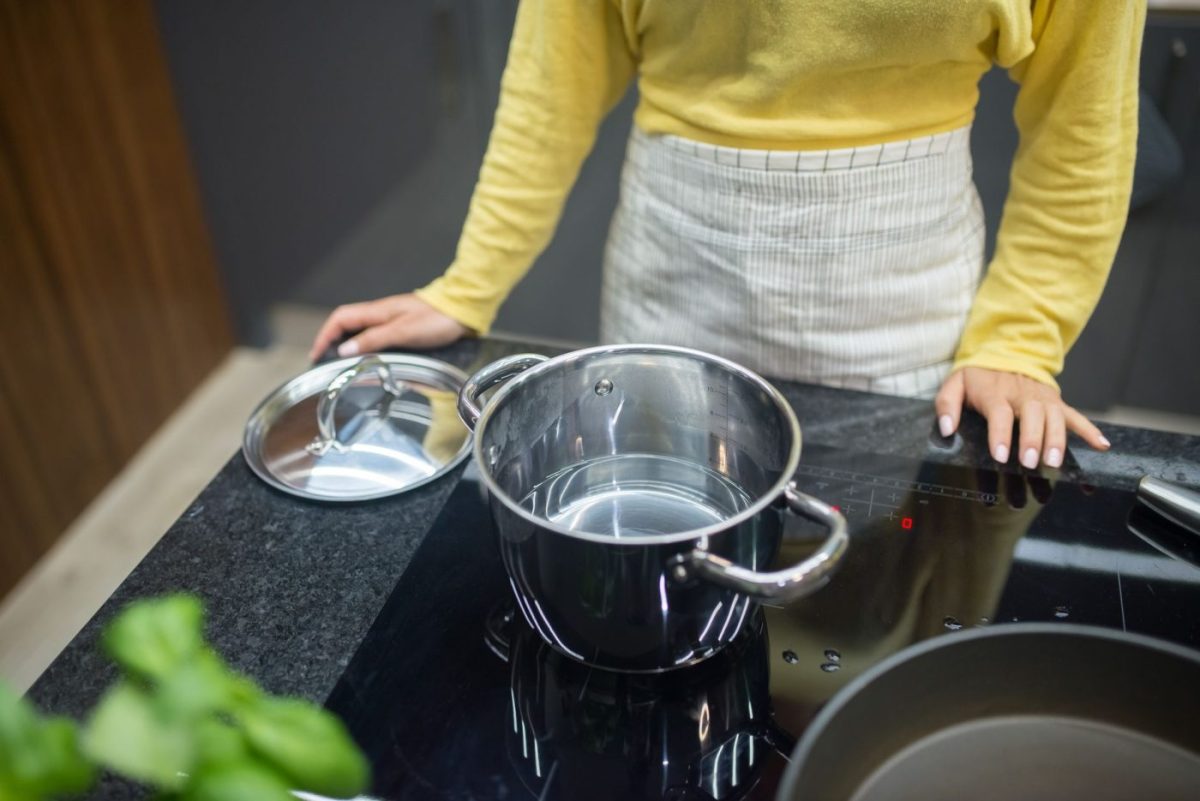
How an induction cooktop heats cookware
A copper coil sits under the glass-ceramic surface. When you switch on a cooking zone, an alternating current at 20 to 100 kHz flows through the coil and creates an alternating magnetic field around it.
The magnetic field passes through the glass ceramic without losses and reaches the base of the pan. If the base is made of a ferromagnetic material such as steel or cast iron, the field induces eddy currents in the metal. The metal's electrical resistance turns these currents into heat, so only the cookware heats up while the cooking zone itself stays cool. There is no flame and no red-hot element.
This is the key safety advantage: heat is generated only inside the pot or pan. The cooktop surface warms up secondarily, only through contact with the hot base. That lowers the risk of burns and fire compared with gas or electric burners.
What radiation does an induction cooktop produce
An induction cooktop generates a low-frequency electromagnetic field, usually in the 20 to 50 kHz range. The field exists only while a zone is running and reaches just a few centimetres from the surface. It is non-ionising radiation, which means it does not damage cell DNA, unlike X-rays or gamma rays.
The field level next to an induction cooktop is typically several times lower than the limits set by the 2020 ICNIRP guidelines. At 30 cm from the front panel it is already no higher than the background level of ordinary household wiring. In a commercial kitchen the chef usually stands further from the source than a home cook, so actual exposure is even lower.
Large epidemiological studies have found no link between using induction cooktops and developing cancer. In a 2022 report, the Swiss Federal Office of Public Health found no carcinogenic effect from low-frequency magnetic fields at the levels typical of kitchen equipment.
Who should be more careful with induction
An induction cooktop poses no threat to most healthy adults. The electromagnetic field weakens quickly with distance, so even 30 cm from the surface its level stays below the background values set by international safety standards. A chef working at the range does not receive a dose that could affect the body.
Some groups of people should consider the possible effect of the magnetic field on medical devices. The risk arises when someone stands right up against a running zone for a long time. That is unusual for commercial kitchen staff, but the limits are worth knowing.
- People with pacemakers. The magnetic field can temporarily disrupt a pacemaker if the chest comes closer than 30 cm to a cooking zone. Medical device manufacturers advise keeping at least 60 cm from the front panel of a running cooktop.
- Insulin pump users. An insulin pump is sensitive to electromagnetic interference, which can affect dosing accuracy. The safe distance is the same as for pacemakers.
- People with implanted defibrillators. The risk works the same way as with pacemakers. Before working with induction equipment, consult a doctor and check the implant manufacturer's recommendations.
- Pregnant women. Studies have found no evidence of harm to the foetus from induction cooktops in normal use. Standing pressed against a running surface for hours is discouraged as an extra precaution, not because of a proven risk.
Can you burn yourself on an induction surface
Yes, a burn is possible, but the mechanism differs from a gas or electric range. The glass-ceramic surface is not heated by the induction coil itself. It heats up only from the hot base of the cookware sitting on it. After you remove a pot or pan, the cooktop stays hot for a while.
Every commercial induction cooktop has a residual heat indicator. This is a light signal, most often the letter "H" or an icon, that stays on while the zone is above a safe temperature. In a commercial kitchen, where staff move fast and touch surfaces often, this indicator is an essential safety feature. It is not a guarantee, but it greatly reduces the risk of accidental contact with a hot zone.
How serious a burn is depends on contact time and the temperature of the cookware that was just removed. In a commercial setting, where pans can reach 250 °C or more, residual heat lasts for several minutes after switch-off. That is why a standard health and safety rule in professional kitchens is to never leave hot cookware on the cooktop unattended and to always check the indicator before wiping the surface.
Which cookware is safe and suitable for induction
An induction cooktop needs cookware with a ferromagnetic base, meaning a magnet will stick to it. This includes cast iron, enamelled cast iron and most magnetic grades of stainless steel. Aluminium, copper, glass and ceramics do not work on their own, because the zone simply does not detect them and will not switch on.
The second critical requirement is the shape of the base. It must be perfectly flat, with no dips or bulges, to make full contact with the glass-ceramic surface. The base diameter should match the zone size or be slightly larger. Cookware that is too small is either not detected or heated in pulse mode, which wears out the electronics.
You can check existing cookware with an ordinary magnet: hold it to the base. If the magnet holds firmly, the cookware is suitable. If it slides or falls off, it will not heat. Steel adapter discs exist for aluminium or copper pans, but they reduce efficiency and slow down heating. In a commercial setting it is more reliable to use cookware marked with a coil symbol or the word “Induction” from the start.
- The base attracts a magnet, which confirms a ferromagnetic layer.
- The base material is solid, without aluminium or copper inserts that break the magnetic field.
- The base stays flat after heating, without warping that causes vibration and noise.
- The base diameter meets the minimum stated in the manual for the specific cooktop model.
- The “Induction” marking or coil symbol is applied by the manufacturer and has not worn off after washing.
Safe operating rules for a commercial kitchen
Daily work with induction equipment calls for simple but clear habits. The main rule is about distance: the chef should stay no closer than 30 cm to the front edge of the cooktop while it is heating. This is not about burns; it reduces the body's exposure to the electromagnetic field to a level that every international standard considers safe.
Pay separate attention to the condition of cookware. Damaged pans with warped bases or cracks break contact with the surface, which leads to uneven heating and overloads the electronics. Such cookware should be taken out of service immediately. Residual heat indicators on the glass ceramic must not be ignored, even when the zone is off. They signal that the surface is still hot from the cookware and warn against contact with bare skin.
For built-in induction units, ventilation is critical. Cooling of the power electronics depends on unobstructed airflow under the housing. Once a week, check that the vents are not blocked with dust or grease, and clean them during deep cleaning according to the manufacturer's instructions. Here are the key rules that professional kitchens put in place:
- Keep at least 30 cm from the front edge of the cooktop while the zones are running.
- Do not use cookware with warped bases, cracks or mechanical damage.
- Watch the residual heat indicators and do not touch the surface right after switching off.
- Check the vents of built-in units weekly for blockages.
- Clean the ventilation grilles on the schedule given in the technical documentation.
- Keep only the cookware you are actually using on the cooktop to avoid accidental heating.
FAQ
Is it true that induction cooktops cause cancer?
No. The electromagnetic field of an induction cooktop is low-frequency non-ionising radiation that does not damage cell DNA. International studies have found no link between using induction cooktops and cancer.
Is induction safe for people with a pacemaker?
Most modern pacemakers are shielded against electromagnetic interference, but manufacturers advise staying at least 60 cm from a running cooking zone. Consult a cardiologist before installing induction equipment.
Why does an induction cooktop make noise while running?
A light hum or buzz comes from the induction coils and vibration of the cookware. This is normal. If the noise becomes harsh or crackling, the cookware base is probably warped or made of an unsuitable material.
Can you use an induction cooktop if the glass ceramic is cracked?
No. Even a small crack can let moisture reach the electrical components, which creates a short-circuit risk. A damaged surface must be replaced before further use.
