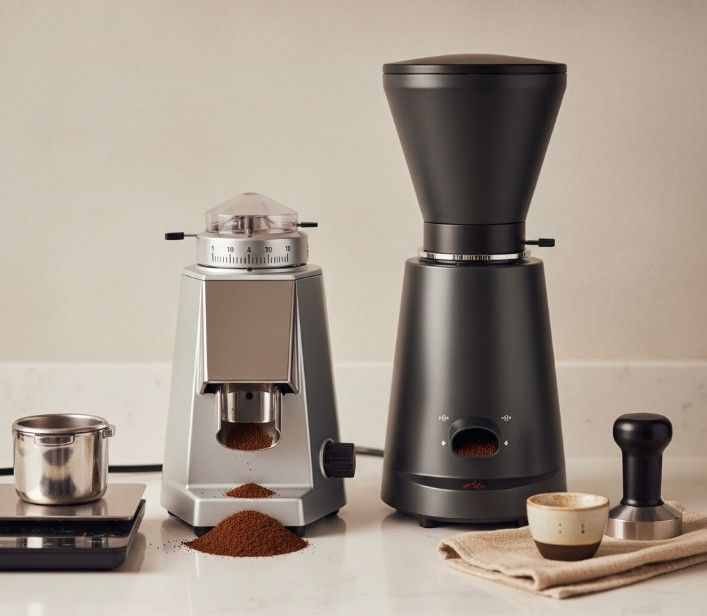
Selecting an espresso grinder often triggers a minor existential crisis in your kitchen. You stand there wondering if you want the rustic, ancestral charm of traditional timber or the cold, industrial reliability of metallurgical engineering. Both are essential pieces of kitchen equipment that serve the same fundamental objective, yet they produce results that feel remarkably disparate when you finally consume that inaugural morsel of a scorching bun. Oh wait, we are talking about coffee now. Achieving that thick, honey-like crema requires a level of precision that cheap blade machines simply cannot provide.
Why do people argue about burr shapes?
The grand divergence resides in how these materials regulate heat and particle distribution during the pulverizing process. Flat burrs function as two parallel rings that sequester beans into a uniform size with surprising efficacy. This prevents those irritating boulders from ruining your extraction and transforming your morning shot into a lamentable, watery disaster. A conical burr coffee grinder, by contrast, establishes a slower thermal environment that operates with less noise but produces a different flavor profile.
- Flat burrs create a unimodal grind size, highlighting the bright, acidic notes in modern light roasts.
- Conical designs are fundamentally quieter, employing a slower motor that avoids traumatizing the beans with excess heat.
- Stainless steel burrs persist for decades through sheer elemental stubbornness, while ceramic versions stay sharp longer under high-volume use.
Is a conical burr coffee grinder better for the body?
Most epicureans reach for a conical burr grinder when manipulating dark roasts that possess the structural fragility of fine parchment. The cone-shaped center burr and outer ring offer a temperate grind that produces a bimodal distribution of particles. Utilizing this specific type of coffee grinders ensures you obtain that quintessential heavy mouthfeel that evokes the atmosphere of a traditional Italian espresso bar. It feels intellectually appropriate, and it prevents the flavor of your shot from becoming too thin or hollow.
Why pick flat burr coffee grinders instead?
If you prioritize clinical clarity and floral sweetness, flat burr coffee grinders triumph over their conical counterparts every time. You can simply adjust the collar by a hair to obtain a level of uniformity that allows every subtle tasting note to shine. It manages high-volume assignments without losing its setting, exhibiting a structural fortitude that cheaper gear simply cannot replicate. Furthermore, it refuses to hide the olfactory profile of your expensive single-origin beans behind a wall of muddy flavors.
- Flat units stack the flavor layers with architectural precision, ideal for those who enjoy complex, fruity espressos.
- You can employ these machines for high-precision pour-over brewing when you aren’t in the mood for a heavy shot.
What are the best burr grinders for espresso at home?
The ultimate decision regarding burr grinders for espresso hinges on the magnitude of effort you wish to dedicate to dialing in your brew. If you relish the meditative ritual of manual adjustment and meticulous weighing of your beans, then a high-end flat burr model is your destiny. For the harried cook who merely desires a reliable instrument that delivers a rich, chocolatey cup in seconds, the conical version is the pragmatic choice. Many sophisticated kitchens retain both versions because certain mornings demand historical flavor depth while others require the cold speed of modernization.
How to compare coffee grinders for longevity?
You can absolutely attain magnificent results with a domestic unit if you employ a rudimentary maintenance stratagem to bypass its limitations. Clean the internal chamber frequently to intercept old oils before they undergo a phase change into rancid flavors. This minor modification grants your steel assembly the metaphorical freshness that is naturally found in a professional cafe setting. Regardless of the material you inhabit, always purge a few grams of coffee when changing settings so your culinary creation remains structurally sound when brewed.
