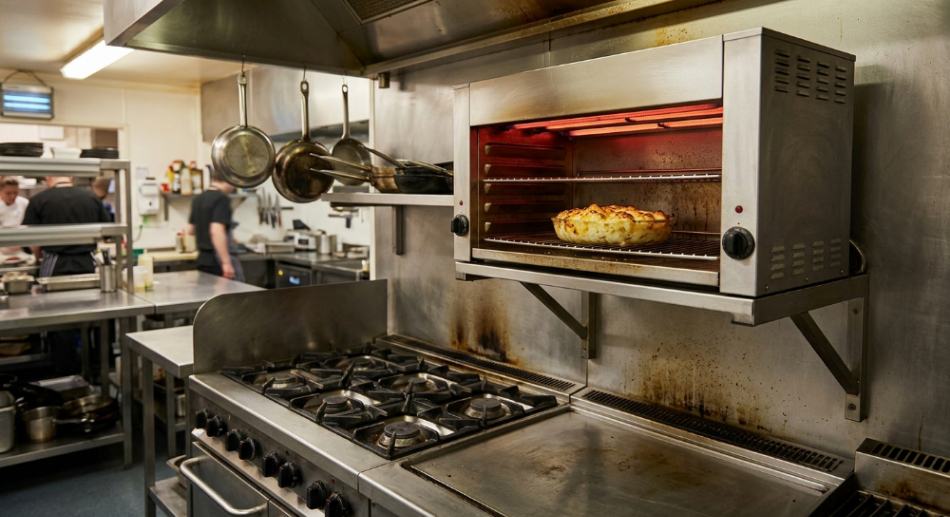
A salamander oven is an open-front broiler that blasts food with heat from above. Restaurants use it for the last minute of a dish: melting and browning cheese, caramelizing sugar, crisping the top of a gratin. You’ll also hear it called a salamander broiler, overhead broiler or finishing oven (CulinaryLore).
Key takeaways
- A salamander heats food from above only. An oven heats from all sides.
- The name comes from an old hand-held iron used for browning, which was named after the mythical fire-proof salamander.
- A salamander puts out much more heat than a cheese melter, even though they look alike (Wasserstrom).
- Home gas salamanders exist but need a vent hood. Cheaper electric units run much cooler.
What is a salamander oven?
It’s a wide metal box with no door. A long burner or heating element runs along the inside of the top. Below it is a rack that moves up and down. Because the front is open, the cook can watch the food and pull it out at exactly the right moment (CooksInfo).
Salamanders come in gas and electric versions, and modern gas models often use infrared burners (CulinaryLore). Restaurant kitchens usually mount them on the wall or above the range, at eye level. There are also smaller countertop models (RecipeTips).
So when someone mentions an “oven with salamander,” they may mean a commercial range with a salamander mounted above it. There’s another possible meaning, covered further down.
What is a salamander used for?
Mostly for finishing. RecipeTips lists browning the top of crème brûlée or an au gratin dish, toasting bread and melting cheese. CulinaryLore adds a detail you may have seen for yourself: pizza places that sell by the slice sometimes run a slice under a salamander to remelt the cheese.
It can do more than that. A salamander can broil food fully, keep plates warm, or bake slowly (CulinaryLore). But what it’s really good at is speed on the surface, not cooking something through.
Why is it called a salamander oven?
Blame an old tool and a very old myth. Long before gas broilers, cooks browned food with a hand-held “salamander.” This was a heavy iron disk on a long handle. It was heated until red-hot, then held over the food (CulinaryLore). Some older versions had little legs, so the iron could sit in the fire while it heated (CooksInfo).
The myth goes back to Pliny the Elder. He wrote that salamanders could put out fire with their bodies, which gave rise to the idea that they were immune to it (Wasserstrom). The name ended up on all kinds of heating devices (Wikipedia). The modern salamander oven inherited it from the old iron, since it does the same job with a lot less work (CulinaryLore).
What’s the difference between a salamander and an oven?
The main difference is where the heat comes from and what it’s for.
| Oven | Salamander | |
|---|---|---|
| Heat | All around the food | From above only |
| Door | Closed | Usually open-front |
| Main job | Baking, roasting, cooking through | Browning, melting, glazing, finishing |
| Speed on the surface | Slower | Very fast |
Here’s how the two work together on the line (a hypothetical example). The cook bakes French onion soup bowls in the oven until they’re hot all the way through. When an order comes in, one bowl goes under the salamander for about a minute to melt and brown the cheese on top. Neither appliance could do the whole job alone.
Salamander vs. broiler vs. cheese melter
All three heat food from above. The difference is how much heat they deliver.
Salamander vs. home broiler
A salamander is a type of broiler, but it’s much stronger than the element at the top of a home oven. CooksInfo says salamanders get much hotter than a home broiler. It also mentions a kitchen nickname for them, “eyebrow broilers,” because standing at eye level with that heat feels like it could singe your eyebrows.
This is where the second meaning of “oven with salamander” may come from. In British English, a broiler is called a “grill,” and CooksInfo notes that nearly all UK home ovens have a separate grill compartment. My guess is that some people searching this phrase have seen the terms used as if they were the same thing.
Salamander vs. cheese melter
A cheese melter looks almost the same as a salamander, but it’s much gentler. Wasserstrom says the biggest difference between them is heat output. A cheese melter is good for melting and holding food warm, while a salamander can brown and broil.
Shoppers should watch for units that use both names. One 1500-watt electric model sold on Walmart as a “cheese melter” and a “salamander broiler” lists a range of 122–572°F. That’s a long way below the figures quoted for commercial gas salamanders.
How hot does a salamander oven get?
It depends on the model, and the published numbers come from manufacturers. BlueStar says its infrared salamander produces 1850°F close to the burner, with gentler heat for food placed further down (BlueStar). One supplier’s blog quotes up to 1850°F for gas models and 700°F for electric (Shinelong).
Those figures describe the heat at the burner, not the temperature of your food. What you actually adjust is the rack. Raise it for a fast, dark crust, or lower it to melt things more gently.
Can you get a salamander oven for home?
You can. The real choice is between a gas unit that needs a hood and an electric unit that’s easier to install but runs cooler.
Home gas salamanders
BlueStar makes a salamander for home kitchens. You can mount it above a BlueStar range or put it on the counter, but it has to be installed with a vent hood (Appliancist; AJ Madison). The current 24-inch model has two separately controlled 19,500 BTU infrared burners, 39,000 BTU in total (2 × 19,500). It has 215 square inches of cooking space and needs a 120-volt electrical supply (Abt).
You get restaurant-style finishing at home. The trade-off is installation: a gas line, proper ventilation and the price of the unit.
Electric countertop units
Electric salamanders and cheese melters plug into a regular outlet and don’t need gas. The model I checked tops out around 572°F, which puts it closer to a strong broiler than to a restaurant salamander. It would handle melted cheese on sandwiches, though I’d expect it to brown more slowly than a gas unit.
Putting a used commercial salamander in a home kitchen is a different matter. CooksInfo says the heat can make it hard to meet fire codes or satisfy your insurer. I haven’t checked this against any specific code, but it’s a good reason to talk to a licensed installer and your insurance company first.
The broiler you already have
In my view, most home cooks can get by with the broiler in their oven, rack in the top slot, for gratins and melted cheese. It’s slower than a salamander. But it costs nothing extra and doesn’t need a hood.
FAQ
How big is a commercial salamander?
CulinaryLore says commercial salamanders run from 3 to 6 feet long, and 3-foot models are the most common. Home units are smaller. BlueStar’s is 24 inches wide.
Can you cook steak under a salamander?
Yes. Salamanders can handle full broiling, not just finishing (CulinaryLore). BlueStar markets its home salamander for steaks as well as finishing dishes.
Is a salamander the same as a toaster oven?
No, though some small salamanders look a bit like a large toaster oven (CulinaryLore). A salamander usually has an open front and much stronger top heat.
Do you need a hood for a home salamander?
For a gas unit, generally yes. BlueStar requires a vent hood for its home salamander. Always check the manufacturer’s instructions and your local code.
A salamander oven exists for the last minute of a dish, when the top needs to brown fast. The name goes back to a red-hot iron and a myth about a lizard that fire couldn’t hurt.
At home, you’re choosing between a gas unit that needs a hood and a cheaper electric one that works more like a strong broiler. Your oven’s broiler is also worth trying before you buy either.
Before you buy a home salamander, check your ventilation and your local installation rules.
