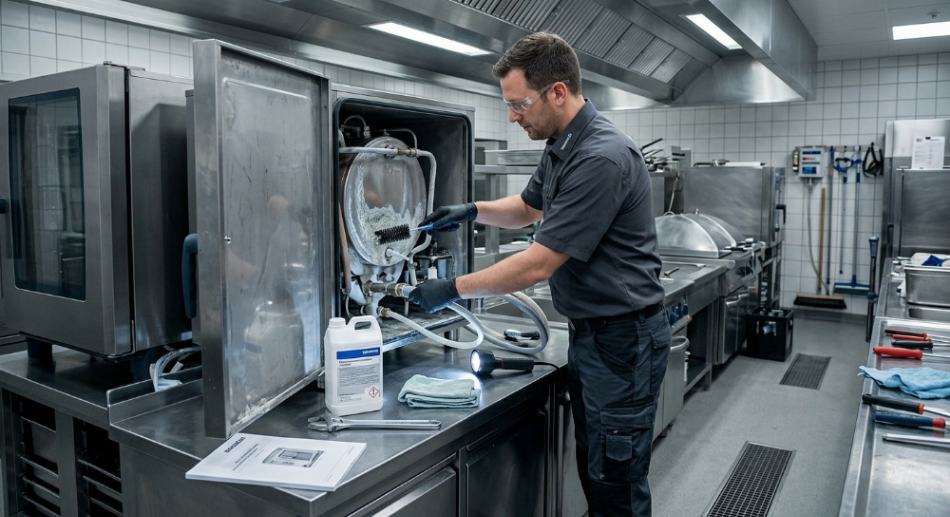
A commercial steamer cooks food with hot vapor instead of direct heat or submerged water. That one difference is why kitchens reach for a steamer over a pot of boiling water: vegetables keep more color and nutrients, rice and seafood cook faster, and none of it needs oil. This guide walks through the main types on the market, where each one actually earns its space on a line, and the maintenance habits that decide whether a unit lasts five years or fifteen.
A few numbers worth knowing before you buy:
- Pressure steamers run roughly 5 to 20 PSI and cook at 225°F to 250°F, well above the 212°F ceiling of open steaming.
- Gas convection steamers typically cost $10,000 to $30,000 depending on pan capacity.
- Most units last 10 to 15 years with proper descaling. Neglect that step and the number drops fast.
- Water quality, not brand, decides how long a boiler-based unit survives.
What Is a Commercial Steamer?
A commercial steamer cooks or reheats food by surrounding it with steam inside a sealed or semi-sealed chamber. Because the heat comes from vapor rather than a flame touching the pan, food cooks evenly without drying out, and it holds onto more of its natural moisture than it would over a burner.
You’ll find steamers everywhere in foodservice: hospitals, school cafeterias, hotels, casinos, independent restaurants. The reason is fairly simple. Steam is fast, it needs almost no added fat, and it treats delicate food gently. Vegetables lose fewer water-soluble vitamins in a steamer than in a pot of boiling water, mostly because less of the food’s surface sits in direct contact with moving liquid.
Two broad categories cover most of the market. Pressure steamers seal the chamber and raise the boiling point of water, which pushes cooking temperatures higher. Pressureless, or convection, steamers circulate steam at normal atmospheric pressure and stay gentler on delicate items. Everything else, connectionless units, steam kettles, microwave steamers, is really a variation built around how the steam gets generated or how portable the unit needs to be.
Which Steamer Types Exist?
Convection steamers are the workhorse of most full-service kitchens. A fan circulates steam evenly around the chamber, the cooking stays gentle enough for eggs and seafood, and the door can be opened mid-cycle to check or season food. It’s the type most operators picture when they hear “commercial steamer.”
Pressure steamers trade that flexibility for speed. Sealing the chamber lets pressure build, which raises the cooking temperature past 212°F and cuts cook times on dense foods like potatoes, rice, and tougher cuts of meat. The tradeoff is that the door stays locked until the cycle finishes, so there’s no checking on food halfway through.
Connectionless steamers skip the plumbing entirely. They fill from a reservoir instead of a water line, which means no drain hookup and no fixed installation point, a real advantage for food trucks, catering rigs, and pop-up kitchens. The cost is manual refilling and slightly more hands-on operation.
Steam kettles work differently from the other four. These are large jacketed vessels built for soups, stocks, and sauces rather than portioned trays. Steam heats the kettle’s outer jacket instead of touching the food directly, so scorching a 40-gallon batch of soup is nearly impossible even at high volume.
Microwave steamers are the newest category, pairing microwave energy with steam generation for near-instant cooking and reheating. They fit quick-service counters and food trucks where turnaround time and footprint matter more than batch size.
Combi ovens sit just outside this list but often come up in the same buying conversation, since they combine convection heat with steam in one cabinet. If you’re weighing a dedicated steamer against a combi oven, our combi oven versus deck oven guide covers that comparison in more depth.
Comparison Table: Commercial Steamer Types
| Type | Heat / Pressure | Typical Use | Water Connection | Maintenance Load |
|---|---|---|---|---|
| Convection | Atmospheric, fan-circulated | Vegetables, seafood, eggs | Usually plumbed | Moderate |
| Pressure | 5 to 20 PSI, 225°F to 250°F | Dense foods, high volume | Plumbed | Moderate to high |
| Connectionless | Atmospheric, reservoir-fed | Catering, food trucks, pop-ups | None (manual fill) | Low |
| Steam kettle | Jacketed, indirect steam | Soups, stocks, sauces | Plumbed | Low |
| Microwave steamer | Microwave plus steam | Quick reheat, portion cooking | Usually none | Low |
How Do Commercial Steamers Work?
Every commercial steamer heats water into steam, then directs that steam onto the food. The three ways units generate that steam, boiler-based, boilerless, and direct steam, shape almost everything else about how the machine runs.
Boiler-based units heat water in a built-in boiler and inject it into the chamber. Recovery between batches is fast, which matters in a busy kitchen, but the boiler’s internals scale up with mineral deposits over time and need regular descaling to keep working.
Boilerless units skip the boiler and heat water in an open pan or spray it onto a heated plate inside the chamber itself. There’s nothing to scale up in the same way, so upkeep is simpler and cheaper, even though recovery between batches runs a little slower.
Direct steam units connect straight into a building’s existing steam line and skip generation altogether. Large hotels and institutional kitchens that already run steam infrastructure often go this route, since there’s no separate boiler and no warm-up time to wait through.
Power source matters too, though not in a one-size-fits-all way. Gas units generally cost less to run at high volume and recover heat faster; electric units install more easily where there’s no gas service and offer tighter temperature control. Which one wins depends entirely on what’s already plumbed into the building, not on which fuel type is objectively “better.”
Where Do Kitchens Use Steamers?
Hospitals and healthcare kitchens lean on steamers for texture-modified and low-fat menus, since steam needs no added oil and cooks gently enough for restrictive diets. School and institutional cafeterias run high-volume kettles and multi-pan convection units to batch-cook vegetables and starches for hundreds of trays in one pass. Hotels and banquet kitchens pull pressure steamers into service during rushes, when dense sides like potatoes and root vegetables need to hit the line fast. Casual and fine-dining restaurants tend to use smaller convection units for a la carte seafood, rice, and vegetable sides cooked to order, while food trucks and caterers favor connectionless or microwave steamers simply because there’s often no plumbing on site to begin with.
If your kitchen also handles a heavy volume of proteins that need to be regenerated without drying out, it’s worth comparing a dedicated steamer against a combi oven before you commit. Our steam equipment category page puts both options side by side.
How Do You Maintain a Steamer?
Maintenance comes down to three habits: clean it daily, descale it on a schedule, and know your water before scale becomes a problem. Skip any one of these and you’re the operator calling for an emergency service visit six months in.
Daily upkeep is the easy part. Wipe down interior and exterior surfaces, check the door gasket for wear, and confirm the drain runs clear. This alone catches most food-safety issues and small leaks before they turn expensive.
Weekly descaling is the step most kitchens skip once things get busy, and it’s exactly the step that shortens equipment life the fastest. Descale the boiler or steam generator, check steam vents for buildup, and inspect hose fittings for leaks while you’re in there.
Water quality gets less attention than it deserves. A boiler-based steamer scales up with mineral deposits the same way a kettle does at home, except a commercial unit runs that cycle daily for years on end. In a hard-water region, an untreated boiler can need descaling every few weeks instead of whatever the manufacturer’s manual says. Some manufacturers will not honor a warranty claim if the water hardness limits weren’t met, so test your water and price a filtration or softening system before you buy, not after the first service call.
A certified technician should inspect heating elements, calibrate controls, and check safety systems once a year, or every six months in a kitchen running multiple shifts. Stay on top of that routine and most commercial steamers will run for ten to fifteen years. Boilerless and connectionless models often go longer, simply because there’s no boiler internals to scale up in the first place.
Common Buying Mistakes to Avoid
A handful of mistakes show up again and again with first-time buyers:
- Sizing for a normal Tuesday instead of peak volume, so the steamer bottlenecks badly during a banquet or holiday rush.
- Skipping the water test, then discovering a softening system is a separate line item after the unit’s already installed.
- Choosing gas without confirming the kitchen’s hood can support it. Gas steamers usually need a Type 1 hood.
- Assuming connectionless means maintenance-free. It doesn’t; these units still need daily cleaning and periodic descaling.
- Buying on price alone. A cheap boiler-based unit in a hard-water region can end up costing more over five years in descaling and service calls than a pricier boilerless model would have.
Choosing the Right Steamer
Match the steamer to your menu’s texture needs, your batch size, and your kitchen’s existing utilities, roughly in that order. A quick-service counter reheating portions all day wants speed and a small footprint, so a connectionless or microwave steamer usually wins. A hospital or institutional kitchen cooking hundreds of trays wants a high-volume convection or pressure unit with a plumbed water line. A caterer without a fixed kitchen wants portability above everything else, full stop.
Buy for what you actually cook most days, not for what you might occasionally need. Our commercial kitchen equipment catalog lets you filter by type, power source, and pan capacity to narrow the decision down quickly.
FAQ
What is the difference between a pressure steamer and a convection steamer?
A pressure steamer seals the chamber and cooks at 225°F to 250°F, faster than atmospheric steaming. A convection steamer circulates steam at 212°F for gentler cooking, and its door can be opened mid-cycle.
How often should a commercial steamer be descaled?
Weekly for most boiler-based units, though hard-water areas may need it every few weeks. Boilerless units need far less frequent descaling since there’s no boiler to scale up.
Do connectionless steamers need a water line?
No. They fill from an internal reservoir and don’t need a plumbed water or drain connection, which is exactly why food trucks and caterers reach for them.
How long do commercial steamers last?
With regular descaling and proper water treatment, most last ten to fifteen years. A neglected boiler-based unit can fail in a fraction of that time.
What size commercial steamer does a small restaurant need?
Most small to mid-size restaurants serving 300 to 800 meals a day do fine with a 5 to 10 pan convection steamer. Menu composition and peak-hour demand matter more than raw headcount.
A commercial steamer earns its place in a kitchen by cooking fast and holding onto nutrients without demanding constant attention. Which type fits comes down to menu, volume, and what’s already plumbed into the building. How long it lasts comes down to something less glamorous: cleaning it daily, descaling it on schedule, and knowing your water before you buy.
Ready to compare units for your kitchen? Browse our full range of commercial steam equipment or contact our team for a sizing recommendation based on your menu and volume.
