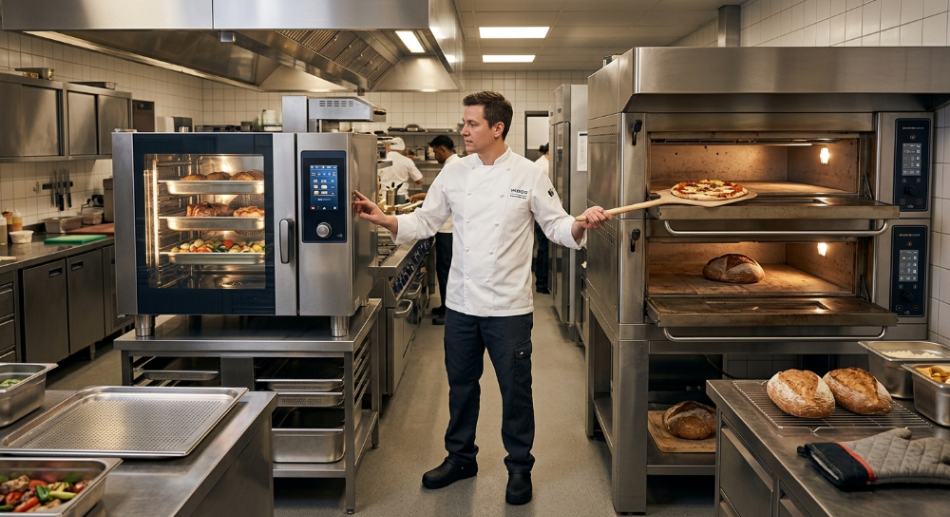
Most comparisons of combi and deck ovens stop at the spec sheet: one is versatile, one makes better crust, pick your menu. That’s true, but it’s also the easy 80% of the decision. The harder 20% – the part that actually determines whether you’re happy with the purchase a year in – is water quality, hood capacity you may not have, the footprint math for a cramped kitchen, and the specific ways operators end up with an oven that sits half-used. This guide covers both halves.
What Is a Combi Oven?
A combi oven (short for combination oven, also called a combi-steamer) runs three cooking modes in the same cabinet:
- Convection mode – circulates dry heat, typically up to around 300°C (572°F), for roasting, baking, and browning.
- Steam mode – injects moist or superheated steam, usually in the 30–130°C (86–266°F) range, for poaching, blanching, and gentle cooking.
- Combination mode – blends steam and dry heat so the kitchen can control humidity while still getting a browned exterior.
Because it can switch modes mid-cycle, a combi oven can roast a protein while holding in moisture that a standard convection oven would cook out. Most units need both a water line and a drain, and boiler-based models require regular descaling to keep the steam system working – more on why that single line item quietly decides total cost of ownership below.
What Is a Deck Oven?
A deck oven bakes food directly on a heated deck rather than in circulated air. Stone and tile decks absorb moisture from the dough as it bakes, which is what gives pizza and bread their characteristic dry, crisp bottom crust and strong oven spring – the rapid rise a loaf gets in the first few minutes of baking. Standard pizza decks typically run up to around 500–550°F, while high-end decks built for Neapolitan-style pizza can push 700–900°F. The tradeoff is preheat time: a stone deck can take 45 minutes to an hour or more to reach operating temperature, so most pizzerias and bakeries keep theirs running for most of the business day rather than cycling it on and off.
Combi Oven vs. Deck Oven: Key Differences
| Factor | Combi Oven | Deck Oven |
|---|---|---|
| Primary use | Multi-protocol cooking: roasting, steaming, regenerating | Pizza, bread, and other deck-baked goods |
| Heat source | Circulated air and injected steam | Radiant and conductive heat from a stone, tile, or brick deck |
| Preheat time | Minutes | 45–90+ minutes |
| Duty cycle | On for the shift, off between shifts | Usually left running most of the operating day |
| Menu versatility | High – can replace several single-purpose units | Narrow – built around one cooking style |
| Water/drain hookup | Usually required | Not required |
| Typical hood requirement | Type 1 for most protein cooking; some listed models allow ventless | Type 1 for gas decks with toppings that render fat; some electric decks may qualify for Type 2 |
| Biggest ongoing cost | Descaling and water filtration | Standing energy cost during long preheat/idle windows |
| Typical setting | Hotels, banquet kitchens, hospitals, multi-cuisine menus | Pizzerias, bakeries, artisan bread programs |
What Do They Cost to Buy and Install?
Prices vary widely by brand, capacity, and whether the unit is new or refurbished, so treat these as general starting points rather than a quote:
| Unit | Entry-Level | Mid-Range | High-Capacity |
|---|---|---|---|
| Combi oven (boilerless) | $8,000–$15,000 | $15,000–$25,000 | $25,000–$40,000+ |
| Single-deck pizza oven | $2,500–$5,500 | $5,500–$10,000 | $10,000–$18,000 |
| Double-deck pizza oven | $5,000–$10,000 | $10,000–$18,000 | $18,000–$30,000 |
Beyond the unit itself, budget for installation. A like-for-like swap onto existing gas, electrical, and hood service usually runs a few hundred to around $1,500. A fresh install that needs a new gas or water line, an electrical upgrade, or hood modifications can run several thousand dollars more – get an installer’s quote before you commit to a model.
The Line Item Most Guides Skip: Water Quality and Descaling
This is where combi ovens quietly get expensive, and it’s almost never on the spec sheet. A combi oven’s boiler and steam generator scale up with mineral deposits from tap water, the same way a kettle does – except a commercial unit runs that process daily, for years. In hard-water areas, an undertreated combi can need descaling every few weeks instead of the manufacturer’s recommended interval, and neglected scale buildup is one of the leading causes of early steam-system failure and costly service calls.
Before you buy a combi oven, get your water tested (or check municipal hardness data) and price out an inline water filtration or softening system alongside the unit – not after installation. A boilerless, direct-steam-injection combi is generally less sensitive to hard water than a boiler-based model, which is worth asking your supplier about directly if your local water is hard. Deck ovens have no equivalent exposure: no water line means no descaling schedule and one less recurring service cost to plan around.
Footprint and Workflow: The Question Most Buyers Forget to Ask
Spec sheets list width, depth, and height. They rarely address how the oven changes the shape of your line. A few things worth walking through before you commit floor space:
- Combi ovens are usually installed at counter height or stacked, and most units need clearance in front for a hinged, outward-swinging door plus room for a cart to catch runoff during unloading – tight in a narrow line.
- Deck ovens are deep and heavy, and multi-deck stacks concentrate a lot of output in a small footprint, but the peel swing radius in front of the oven needs to stay clear during service – a common mistake is boxing that zone in with a prep table.
- Heat bleed matters more than either spec sheet mentions: a deck oven running most of the day raises ambient kitchen temperature nearby, which affects anything proofing, chilling, or plating close to it.
Ventilation: What Each Oven Needs Overhead
Most gas deck ovens and combi ovens cooking proteins fall under Type 1 hood requirements because they produce grease-laden vapor. As a rough guide, a medium-duty wall canopy hood (covering ranges, gas convection ovens, and standard pizza decks) is typically sized around 300 CFM per linear foot of hood, while heavy-duty equipment like fryers and charbroilers needs closer to 400 CFM per linear foot. Some ventless combi models carry a listing that allows installation without a full Type 1 hood under specific conditions – confirm this with your local inspector (the authority having jurisdiction) before you spec a unit around it. For the full picture on sizing and code requirements, see our guide on designing a commercial kitchen exhaust system and our guide to picking the right range hood.
How Long Do These Ovens Last?
A well-maintained commercial oven from a reputable brand commonly runs somewhere in the 12–20 year range, though the components that fail first differ by type:
- Combi ovens – typically 10–15 years if descaled on the manufacturer’s schedule; hard water without treatment shortens that considerably.
- Deck ovens – often the longest-lived option, since a stone or tile deck has few moving parts; heating elements and door seals are the parts most likely to need replacement over time.
Ask your supplier for the manufacturer’s stated service life and maintenance schedule for the specific model you’re considering, since figures vary between brands. If long-term running cost is a factor, ask about energy-efficient commercial oven models as well – certified units typically cost more upfront but use less water and power over their lifespan.
Three Kitchens, Three Answers
Specs aside, here’s how the decision actually plays out in practice:
- A 60-seat neighborhood pizzeria doesn’t need a combi oven at all – a double-deck gas oven covers pizza, focaccia, and calzones, stays hot through the rush, and keeps the equipment list (and the hood spec) simple. A combi would sit idle most nights.
- A 200-room hotel with a banquet department leans hard on combi ovens because the job is regenerating hundreds of plated proteins and vegetables without drying them out between the kitchen and the ballroom – a task a deck oven isn’t built for.
- A bakery-café hybrid selling both bread and quiche often ends up running both: a deck oven dedicated to bread where crust is non-negotiable, and a smaller combi oven for pastries, quiche, and morning regeneration. The combined footprint and hood load has to be planned from day one, not added on later.
When Should You Choose a Combi Oven?
A combi oven earns its space when a kitchen needs flexibility more than a single signature result:
- High-volume banquet or catering operations that need to regenerate pre-cooked food without drying it out
- Multi-cuisine menus that move between roasting, steaming, and baking throughout a shift
- Hotel and institutional kitchens looking to consolidate a convection oven, steamer, and holding function into one footprint
- Ghost kitchens and multi-brand delivery operations that need one compact unit to cover several menus at once
When Does a Deck Oven Make More Sense?
A deck oven wins when the crust itself is the product:
- Pizzerias and bakeries where bottom-crust texture defines the menu
- Single-concept kitchens that don’t need steam or regeneration functions
- Operations that want a simpler unit with fewer moving parts to maintain, and no water-quality dependency
Can a Kitchen Use Both?
Plenty of kitchens run a combi oven and a deck oven side by side – the combi oven handles proteins, vegetables, and banquet regeneration, while the deck oven stays dedicated to pizza or bread. If you’re planning both, factor the extra heat load and hood coverage into your ventilation design before installation, since two high-heat appliances change your CFM math, and plan the water line for the combi and the peel clearance for the deck oven on the same drawing rather than resolving them separately.
Common Buying Mistakes
- Sizing the combi oven to current volume, not peak volume. Banquet and catering demand spikes; an undersized combi becomes a bottleneck exactly when it matters most.
- Skipping the water test. Buyers price the oven and the installation, then discover a softener or filtration system is a separate five-figure line item after the unit arrives.
- Underestimating deck preheat time in the daily schedule. A deck oven that isn’t fired up 45–90 minutes before service opens isn’t ready when the first ticket comes in.
- Assuming ventless combi status transfers between locations. A listing that let you skip a Type 1 hood at one address doesn’t automatically apply elsewhere – local code and the authority having jurisdiction have the final say.
FAQ
Is a combi oven worth it for a small restaurant?
If your menu spans roasting, steaming, and reheating, a combi oven can replace two or three single-purpose units, which often justifies the higher upfront cost in a small footprint. If your menu is narrowly pizza or bread, that flexibility goes unused and a deck oven is the better dollar-for-dollar choice.
Do combi ovens replace steamers and convection ovens?
In most kitchens, yes – a combi oven covers what a standalone steam equipment unit and a convection oven would do separately, though very high-volume steaming operations may still run a dedicated steamer alongside it.
Can a deck oven bake anything besides pizza?
Yes. Bread, focaccia, and some pastries also benefit from direct deck contact, which is why many bakeries choose a deck oven over a convection model.
Does a combi oven need a water line?
Most boiler-based and injection-style combi ovens need both a water supply and a drain. Confirm this with the manufacturer’s spec sheet before installation, and ask specifically whether the model is boiler-based (more sensitive to hard water) or direct-steam-injection (generally more tolerant), since that affects your descaling costs long-term.
Do I need a Type 1 hood over a deck oven?
Usually, if the oven cooks pizza or other items with rendering fat or toppings that produce grease-laden vapor. Some electric decks baking dough and cheese only, without raw protein toppings, may qualify for a lighter Type 2 hood – check with your local inspector before you finalize your hood plan.
Which oven has lower running costs?
A deck oven typically stays on continuously through service, while a combi oven can be powered down between uses – but exact energy costs depend on unit size, fuel type, and local utility rates. For combi ovens, also factor in the recurring cost of water filtration and descaling, which deck ovens don’t have at all; ask your supplier for model-specific figures on both.
How do I know if my kitchen actually needs both?
If more than one core product on your menu depends on a cooking method the other oven can’t replicate – deck-baked crust on one side, steam-regenerated proteins on the other – running both is usually cheaper long-term than compromising on either. If only one product line depends on it, start with the single oven that matches your primary menu and revisit later.
Ready to compare units side by side? Browse our full range of commercial kitchen equipment to find the oven that fits your menu, your space, and your water – not just your budget.
