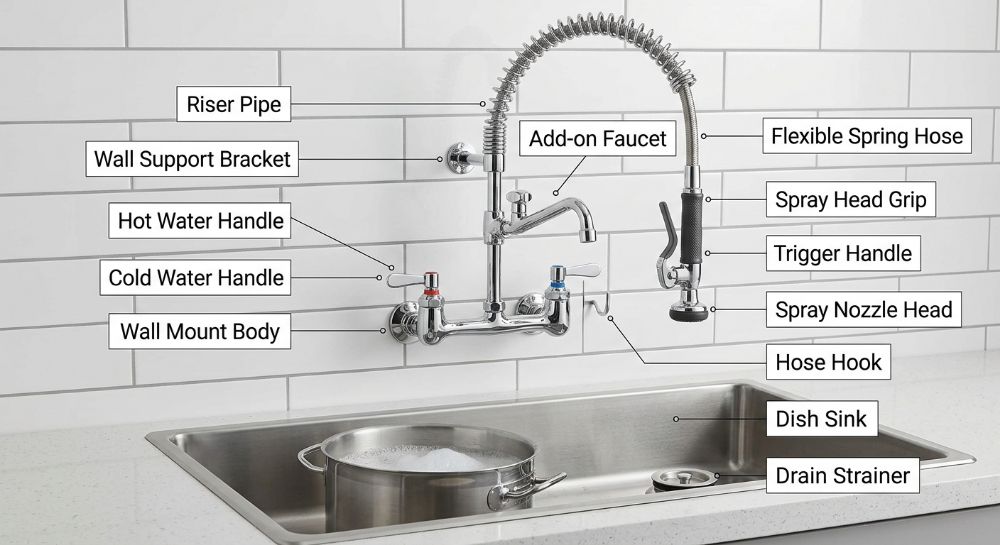
A commercial kitchen faucet with sprayer is a tall, heavy-duty faucet with a spring-held hose and a spray valve, used to rinse food off dishes before they go into the dish machine. In the trade, it’s called a pre-rinse faucet, or sometimes a pre-rinse unit. Choosing one comes down to four things: how it mounts, how far apart the inlets are, whether you want an extra spout, and how much water the sprayer uses.
Key takeaways
- Where your water lines come out decides the mount: from the wall means a wall-mount unit, and through the deck means a deck-mount unit.
- Measure from the center of the hot inlet to the center of the cold inlet. The common sizes are 8 inches and 4 inches.
- Under current federal rules, spray valves made since January 28, 2019 can use no more than 1.00 to 1.28 gpm, depending on spray force (eCFR, 10 CFR 431.266).
- In May 2025, the DOE proposed going back to the older 1.6 gpm limit. Check the current rule before you order.
What is a commercial kitchen faucet with sprayer?
It’s a faucet built around a pre-rinse spray valve. The DOE defines that as a handheld device with a release-to-close valve that removes food residue before dishes go into commercial dishwashing equipment (eCFR, 10 CFR 431). Release-to-close means the water stops as soon as you let go.
Most pre-rinse faucets share the same basic setup. There’s a base with hot and cold valves, usually made of brass. A tall riser pipe with a spring holds the hose up. Then there’s the hose and spray valve, and a wall bracket to keep the riser steady. Many models also add a swing spout for filling pots.
Wall mount or deck mount: which do you need?
Start at the sink, not the catalog. If the supply lines come out of the wall above the sink, you need a wall-mount unit, which some sellers call splash-mount or backsplash-mount. If they come up through holes in the sink deck or counter, you need a deck-mount unit. Both styles are widely sold (WebstaurantStore).
Here’s what can go wrong (a hypothetical example). A diner replacing a leaking pre-rinse faucet orders a deck-mount model because it looks like the old one in the photo. When it arrives, they find the old one was fed from the wall. It can’t go in without new plumbing, and the dish station is down while they wait for the right part. Two minutes with a flashlight under the sink would have caught it.
How do you measure faucet centers?
Centers are the distance from the middle of the hot inlet to the middle of the cold inlet. You’ll mostly see 8-inch and 4-inch centers. Retailers stock both, for example 8-inch wall-mount pre-rinse faucets and 4-inch deck-mount “mini” units (WebstaurantStore).
Some bases have a bit of adjustment. One 8-inch wall-mount model can be set anywhere from 7.95 to 8.34 inches by rotating the base (manufacturer installation guide, via manuals.plus). So if you measure 8¼ inches, an adjustable 8-inch unit may still work.
Check the thread size too. Many pre-rinse faucets use 1/2″ NPT inlets, which is a standard pipe thread (WebstaurantStore).
Do you need an add-on faucet?
An add-on faucet is a separate swing spout on the same unit, used for filling pots, buckets or the sink. Common lengths include 8, 12 and 14 inches (WebstaurantStore; Waterloo).
Whether it’s worth having depends on how the sink is used. If the prep cook fills stockpots there, the extra spout saves a walk to another sink. If the sink is only for rinsing dishes, you’re paying for one more valve that could start dripping.
What flow rate should a pre-rinse sprayer have?
Under the rules in force as of this writing, it can’t use more than 1.28 gallons per minute (gpm). The exact limit depends on the sprayer’s spray force.
The current DOE limits
Spray valves made on or after January 28, 2019 are grouped by spray force, meaning how hard the water hits, measured in ounce-force (ozf). Each class has its own maximum flow (eCFR, 10 CFR 431.266):
| DOE class | Spray force | Maximum flow |
|---|---|---|
| Class 1 | 5.0 ozf or less | 1.00 gpm |
| Class 2 | More than 5.0, up to 8.0 ozf | 1.20 gpm |
| Class 3 | More than 8.0 ozf | 1.28 gpm |
The earlier federal limit was 1.6 gpm, set by the Energy Policy Act of 2005. Sprayers made before that law often used 3.0 to 4.5 gpm (EPA WaterSense).
In the product listings I looked at, 1.15 gpm at 60 psi came up often. One model was rated as low as 0.65 gpm (WebstaurantStore; Waterloo). That’s a small sample, not a survey of the whole market.
The 2025 rollback proposal
In May 2025, the DOE proposed scrapping the 2019 limits and going back to the 1.6 gpm limit set by Congress (Federal Register, May 16, 2025). I couldn’t confirm whether a final rule has been issued. Before a large order, check the current text of 10 CFR 431.266 or ask your supplier.
How much water does a lower-flow sprayer save?
That depends on how long the sprayer runs. Take a hypothetical kitchen where it runs for a total of 60 minutes a day:
- A 1.6 gpm sprayer: 1.6 × 60 = 96 gallons a day
- A 1.15 gpm sprayer: 1.15 × 60 = 69 gallons a day
- The difference: 27 gallons a day, or about 9,720 gallons a year if the kitchen is open 360 days (27 × 360)
The EPA says swapping a sprayer that runs at 1.6 gpm or more for a DOE-compliant one saves a significant amount of water and energy. For most facilities, it says, the new sprayer pays for itself in under a year (EPA WaterSense). For a sense of scale, going from 1.6 to 1.28 gpm is a 20% drop: (1.6 − 1.28) ÷ 1.6 = 0.20.
A weak spray can cancel some of that saving, though. Staff end up holding the trigger longer to get the same result (KaTom). That’s why the DOE classes are based on spray force. If your plates often come back crusted with baked-on food, a Class 3 valve may get them clean faster and use less water in the end.
Does a pre-rinse faucet need to be lead-free?
Yes, if it supplies water that people will drink or cook with. Under the Reduction of Lead in Drinking Water Act, in effect since January 4, 2014, “lead free” means no more than a 0.25% weighted average of lead on the surfaces the water touches (Virginia Department of Health).
When you compare products, check the specifications for certification to NSF/ANSI/CAN 372 or NSF/ANSI/CAN 61. Either mark shows the product meets the lead-free requirement (NSF).
Other things to check before you order
Water pressure. A sprayer only delivers its rated flow if the pressure is right. The EPA recommends keeping system pressure between 20 and 80 psi, and most ratings are measured at 60 psi.
Cartridges. Many units use quarter-turn ceramic cartridges, so a quarter turn of the handle opens the water fully (WebstaurantStore). I couldn’t find independent data on how long they last compared with other valve types, so I’m not making a claim either way.
Spare parts. Spray valves wear out. The Appliance Standards Awareness Project puts their average life at about 5 years. If spare hoses and valves for your brand are easy to find, you can replace one part instead of the whole faucet.
FAQ
What’s the difference between a pre-rinse faucet and a regular commercial faucet?
A pre-rinse faucet has a spring riser, a hose and a spray valve for rinsing dishes. A regular commercial faucet usually has just a spout. Many pre-rinse faucets include a spout too, so one unit covers both jobs.
Can you install a commercial kitchen faucet with sprayer at home?
Yes, as long as the mount type, centers and thread size match your sink and supply lines. Home sinks vary, so measure first.
What gpm should a pre-rinse sprayer be?
Under current federal rules, no more than 1.28 gpm, depending on spray force. Many listed units are rated at 1.15 gpm at 60 psi.
How long does a pre-rinse spray valve last?
About 5 years on average (ASAP). Replace it sooner if it drips, leaks at the handle or loses spray force.
Most of the work in choosing a commercial kitchen faucet with sprayer happens before you shop. Check whether the lines come from the wall or the deck, measure the centers and note the thread size. Then choose whether you want an add-on spout and which spray force suits your dishes.
Keep an eye on the federal flow rules, which could change if the 2025 proposal goes through.
Before you order, measure your inlet centers and check whether your supply lines come from the wall or the deck.
