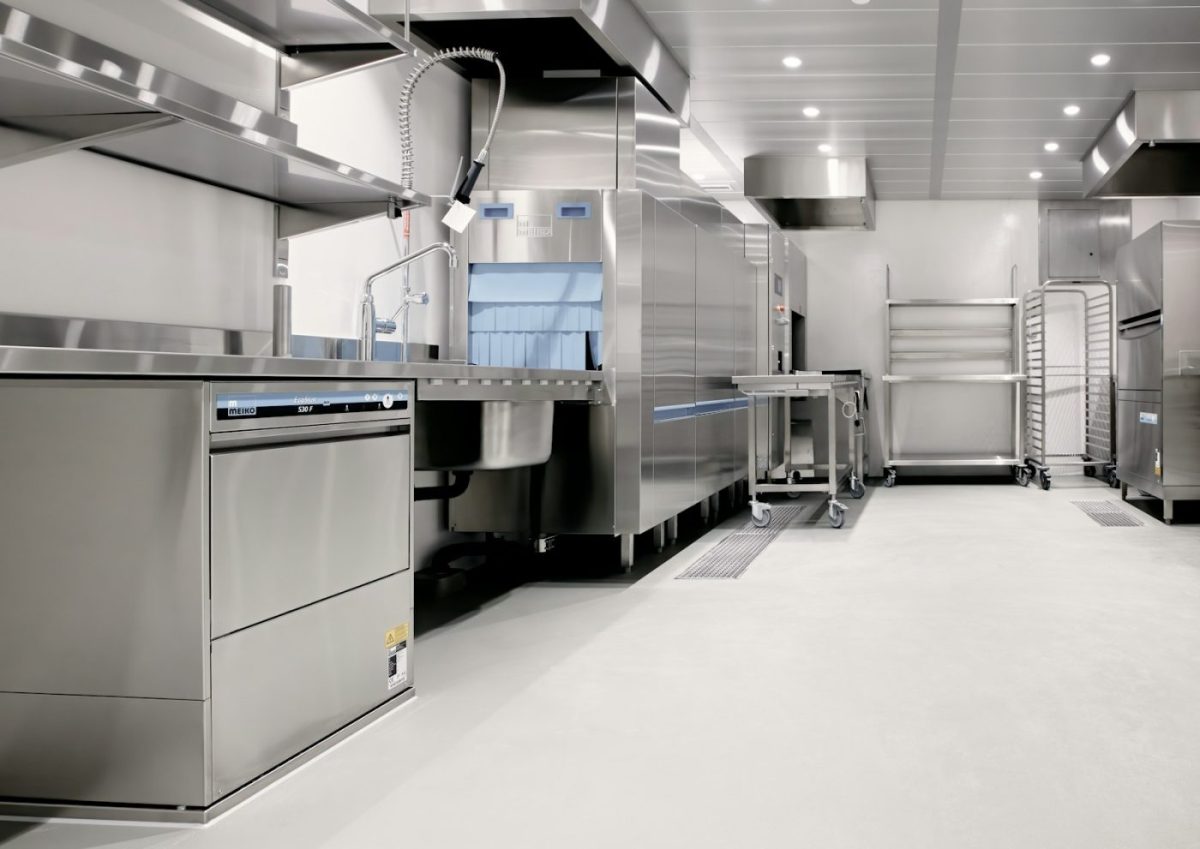
What does the energy efficiency class on a commercial dishwasher actually measure?
The letter grade on a commercial dishwasher label, from A+++ down to D, reflects the machine's consumption of electricity and water per standard rack or basket during a defined test cycle. The test simulates washing a full load of soiled ware under repeatable conditions, so you can compare models directly. The grade is not a general quality score; it is a measurement of resource use for a specific workload.
The EU regulation bases the rating on the Energy Efficiency Index (EEI). The EEI compares the machine's actual annual energy consumption against a benchmark for its category, such as undercounter, hood-type or pass-through. A lower EEI means a higher efficiency rating. The calculation factors in standby power draw and the water volume used during the cycle because heating that water dominates energy use.
For a busy kitchen, the class tells you how efficiently the machine handles each rack. A hood-type unit rated A+++ might use under 1.2 kWh and 9 litres of water per rack, while a D-rated equivalent could draw more than double that. The test uses a standard detergent and specified inlet water temperature, so your actual figures will vary with your supply conditions and chemical dosing.
How much water and electricity does each efficiency class use in a real kitchen?
An undercounter A-class machine typically uses 2.5-3.0 litres of water per rack, while a B-class model draws 3.5-4.5 litres. Electricity consumption follows a similar spread, with A-class units pulling 0.7-0.9 kWh per cycle and B-class units closer to 1.0-1.2 kWh. Hood-type machines shift the numbers upward: an A-class hood machine consumes roughly 2.0-2.5 litres per rack, and a C-class alternative can exceed 4.0 litres.
Flight-type conveyors, common in high-volume hotels and canteens, show the widest gap. An efficient A-class flight machine uses 1.5-2.0 litres per rack, whereas a lower-rated C-class unit often runs at 3.5-4.5 litres. Multiply these figures by a realistic daily rack count to see the financial weight of the label.
Consider a 120-cover restaurant running a hood-type machine through 200 racks per shift:
- A-class: 200 racks × 2.2 L = 440 L of water and roughly 11 kWh for the shift
- C-class: 200 racks × 4.0 L = 800 L of water and roughly 16 kWh for the shift
- Daily water saving with the A-class unit: approximately 360 litres
- Annual water saving at 340 operating days: about 122,000 litres
- Added electricity saving over the same year: roughly 1,700 kWh
- Total utility reduction translates directly into lower wastewater charges and a shorter payback period for the machine
What other numbers on the label matter besides the big letter grade?
The large letter grabs attention, but a machine that earns an A rating while running 18 hours a day can still cost more to operate than a B-rated model with lower cycle consumption. The detailed figures show what the grade means for your kitchen.
Compare these five figures on every EU and UK commercial dishwasher label before you buy.
- Annual energy consumption in kWh. This number is calculated from 280 standard cycles per year. Multiply it by your local electricity rate to get a baseline running cost, then adjust upward for a kitchen that runs 10 to 20 cycles a day rather than 280 a year.
- Water consumption in liters per cycle. A machine using 2.5 liters per rack versus one using 4.0 liters saves over 1,000 liters per 700-rack day. Water cost is modest, but the real saving is in the energy needed to heat every extra liter.
- Drying efficiency class. Rated from A to G on a separate scale. A lower drying grade forces staff to hand-polish glassware or leaves spotty results. This matters most in open kitchens and fine dining.
- Noise level in dB. A 45 dB machine is barely audible in a dining room. A 65 dB unit makes normal conversation difficult. Open kitchens and pass-through counters need a number under 55 dB.
- Rated capacity in racks per hour. The label states the machine's throughput under standard test conditions. If your peak lunch service demands 35 racks and the label says 30, you have a bottleneck regardless of cycle efficiency.
Does a higher efficiency rating always mean lower running costs for my kitchen?
A higher rating points to lower consumption per cycle, but it does not guarantee lower total running costs. The machine type affects costs more than the letter grade. An A-rated undercounter dishwasher typically uses 2.0-2.5 litres of water per cycle, while a C-rated hood-type machine can use 3.0-4.0 litres. The hood-type unit washes a rack in 60-90 seconds, however, and handles 60-100 racks per hour. The undercounter machine takes 2-3 minutes per cycle and manages 15-30 racks. In a busy kitchen the hood-type machine finishes the work in half the time, which cuts labour hours and frees staff for other tasks.
Purchase price is the other side of the equation. A high-efficiency hood-type machine often costs 30-50% more than a mid-range model with a lower rating. The payback period from utility savings alone can reach 4-7 years in a medium-volume kitchen. If the kitchen runs only 20-30 cycles a day, the annual saving from upgrading from class C to class B might be modest: roughly 15-25 cubic metres of water and 400-600 kWh of electricity. At that volume, the C-rated machine's lower purchase price often makes more financial sense.
A lower rating is the rational choice when:
- The kitchen operates fewer than 30 cycles per day and the utility rate is low.
- Speed and throughput are the priority, and a faster machine with a lower rating reduces overtime.
- The available budget is tight and the higher upfront cost of an A-rated model cannot be recovered within the lease term or planned equipment life.
- The machine is a backup unit used only during peak hours or when the main machine is down.
- Water and electricity prices are subsidised or included in a fixed service charge for the premises.
How do I calculate the annual savings if I upgrade to a more efficient machine?
To calculate savings, take three numbers from each machine's energy label: energy per cycle in kWh, water per cycle in liters, and your annual cycle count. A realistic 200-rack-per-day kitchen runs about 200 cycles daily, as most commercial units handle one rack per cycle.
Multiply the difference in kWh per cycle by your daily cycles, then by 365 days, and finally by your electricity rate per kWh. Do the same for water: difference in liters per cycle times daily cycles times 365, converted to cubic meters and multiplied by your water and sewer rates.
An upgrade from an older C rated machine using 0.12 kWh and 3.2 liters per cycle to a modern A rated model using 0.08 kWh and 2.4 liters per cycle, at rates of $0.15 per kWh and $4 per cubic meter of water, saves roughly $440 in electricity and $230 in water annually, for a total of about $670 before factoring in detergent and rinse aid reductions.
What changed in the energy label regulations for dishwashers after 2021?
In March 2021 the European Union rescinded the old A+++ through D scale for dishwashers and replaced it with a simpler A to G system. The previous label had become crowded at the top, with most machines clustered in the A+, A++ and A+++ bands, making it difficult to distinguish genuinely efficient models from average ones. The new label clears that logjam. A machine that was rated A+++ under the old rules now typically lands in class C or D on the new scale.
The A and B classes on the post-2021 label are deliberately left empty for now, reserved for future models that exceed current performance benchmarks. If you see a commercial dishwasher still carrying an A+++ sticker, that machine was manufactured or placed on the market before the switchover deadline. Its real-world consumption has not changed. You can compare it against a new-label machine by checking the kilowatt-hours and litres per cycle printed on both labels, not by matching the letter grades.
Suppliers can sell old-label stock until it runs out, so both formats appear in showrooms and warehouses. The label also added a QR code linking to the public EPREL database, where you can verify the declared figures against the manufacturer's filed test results.
FAQ
Can I trust the energy label numbers in a busy restaurant where we run the machine non-stop?
The label shows consumption under a standardized test cycle. In a real kitchen, hot water inlet temperature, detergent choice and how often you run half-empty racks will shift the actual figures. Use the label as a baseline for comparison between models, not as a precise utility bill forecast.
Does a machine with a built-in heat pump always get a higher rating?
Heat pump models typically reach class A or B because they recover waste heat to preheat incoming water. The rating reflects that lower energy draw, but you also get a machine that dumps less hot air into the kitchen, which can cut your HVAC load in summer.
Why do two machines with the same letter grade show different kWh per year?
The letter grade is a band. One machine may sit near the top of the band and another near the bottom, so their absolute consumption numbers differ. Always compare the annual kWh and liters per cycle figures printed on the label, not just the letter.
How do I compare an old A+++ label with the new A-G scale?
An old A+++ roughly maps to a new C or D on the rescaled 2021 label, because the scale was tightened to leave room for future improvements. When replacing equipment, compare the actual kWh and water figures from both labels rather than trying to translate the letter grades directly.
