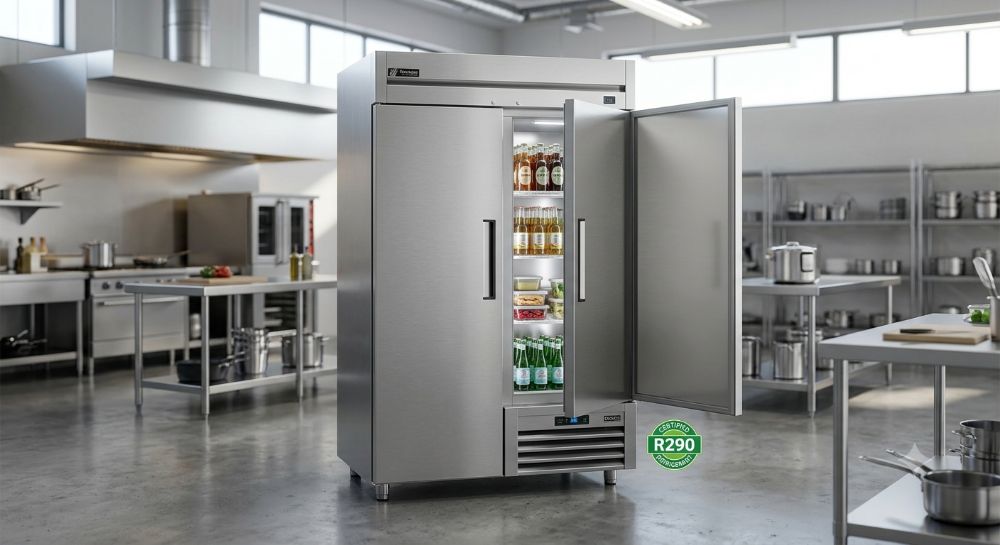
R-290 is propane. Same gas, just doing a different job. It’s turning up in commercial fridges now because it cools just as well as the old stuff and does far less damage on the way out the door.
You’ll find R290 mostly in small, self-contained units. Reach-in coolers. Beverage merchandisers. Ice cream freezers. Its GWP sits at 3. R134a, the gas it’s pushing out of a lot of equipment, sits at 1,430. Big gap. And no, you can’t drain the old gas out of an R134a unit and pour R290 in. The fridge has to be built for it, from the factory floor up.
What Does R290 Refrigerant Mean?
R290 is the refrigerant industry’s code for propane. Same molecule you’d find in a camping stove, just used differently here. It’s classified A3 under ASHRAE 15, meaning higher flammability, low toxicity. Ozone depletion potential is zero, the whole point of switching in the first place.
Here’s the part that shapes how these fridges get built: flammability. More gas in one sealed circuit means a bigger problem if it leaks. So manufacturers cap the charge low and keep every electrical component sealed away from where leaked gas would settle. Not a design choice anyone loves. A constraint everyone’s building around.
Is R290 Used in Commercial Fridges?
Yes, and more of them every year. Reach-in coolers, under-counter units, beverage cases, some medical and pharmacy fridges, they all commonly run on it now, including a lot of the commercial refrigerators for small restaurants sold today. Walk-ins mostly don’t. Their refrigerant circuits are too large to squeeze under the safety limits that apply to A3 gases, so this stays a small-equipment story for now.
The safety limit itself has moved, which is honestly the more interesting part. Self-contained commercial units used to be capped at 150 grams of R290 per circuit under IEC 60335-2-89. The 2019 revision, adopted into the harmonized EU standard in 2022, bumped that ceiling to 500 grams for a lot of equipment categories. One number change on a technical standard, and suddenly R290 stopped being the niche pick and started being the default one for reach-in refrigeration.
What Refrigerant Do Most Fridges Run On Now?
| Refrigerant | GWP | Common Use |
| R404A | 3,922 | Older commercial units, phasing out |
| R134a | 1,430 | Still common, being replaced |
| R290 | 3 | New self-contained units |
A convenience store swapping its reach-in beverage coolers from R404A to R290 typically sees energy use drop somewhere in the 5 to 8 percent range, according to field data from refrigeration equipment suppliers. Pair that with a variable-speed compressor and the gap can widen further. Not a dramatic number on its own, but it adds up across a dozen units running all day, every day.
Can I Replace R290 with R134a, or the Other Way Around?
No, not as a simple swap, and don’t let anyone tell you otherwise. The two gases run at different pressures and treat the oils and seals inside a compressor differently. A fridge built for R134a lacks the flammability safeguards an A3 gas needs. A fridge built around R290’s small charge limit isn’t sized to run R134a efficiently either. Neither direction works.
If you’re stuck with older equipment and want to shrink its footprint, retrofitting usually isn’t worth chasing. Buying a unit factory-built for R290 tends to work out safer and cheaper than trying to convert what’s already sitting in your kitchen. If you’re not sure where to start, a guide on choosing the right commercial refrigerator covers the basics beyond just refrigerant type.
A few things worth knowing before you buy:
- Check the nameplate for the actual gram charge, not just the refrigerant type, since two R290 units can carry very different amounts
- Confirm the unit is certified under the current edition of UL 60335-2-89 or EN IEC 60335-2-89, not an older version still floating around in older stock
- Ask about minimum room size requirements if the charge is on the higher end, since some codes require extra floor space for ventilation once you pass a certain gram threshold
What Changes by 2026?
Refrigerant rules keep tightening, and honestly they’re not slowing down anytime soon. In the US, the EPA’s AIM Act phase-in caps new commercial refrigeration equipment at a GWP of 150 or lower starting in the 2026 to 2027 window. R290 clears that bar without breaking a sweat, sitting at a GWP of 3. In the EU, tightening F-Gas quotas are pushing R134a out of new equipment on a similar timeline. Nobody’s banning your existing fridge overnight. But the next unit you buy is increasingly going to run on propane, whether that’s why you picked it or not.
So here’s the practical move: ask the supplier what refrigerant is in the unit and what its GWP number actually is, before you sign anything. Still R404A or R134a? Not automatically a dealbreaker today. But it’s worth asking how much longer that model stays in production before the rules push it out for good. Whatever you end up buying, staying on top of refrigeration upkeep matters just as much as the refrigerant inside it.
