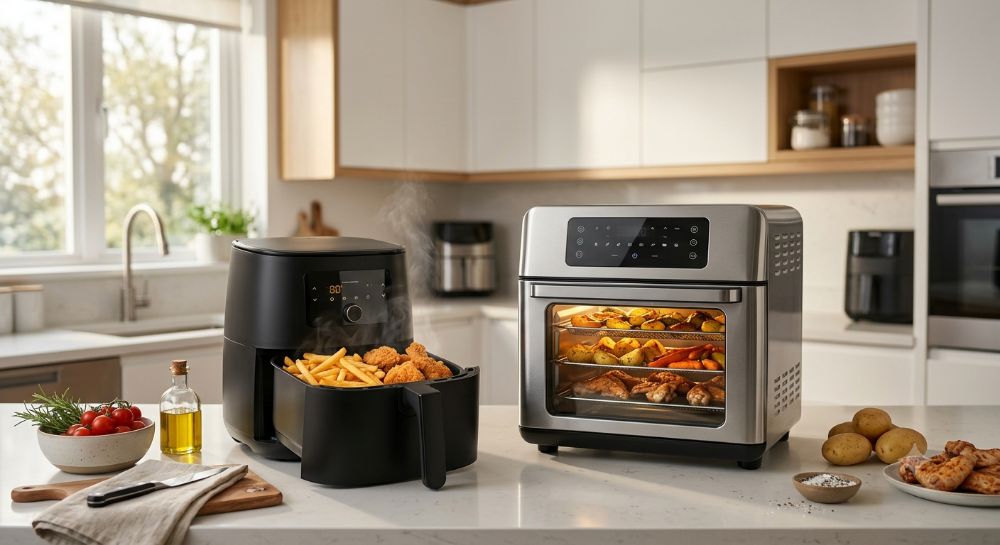
An air fryer is a small convection oven. It blasts hot air around food instead of drowning it in oil. Simple enough. Picking the right one gets complicated fast, but really it boils down to three things: capacity, wattage, and whether a basket or oven-style layout fits on your actual counter, not the roomy one in the store display.
Сooking for one or two, get a 3 to 4-quart basket model at 1400 to 1500 watts. Feeding a family of four or more? Skip the basket. Get a 6 to 8-quart oven-style unit instead. Small baskets look great on the shelf, right up until you’re running the thing three times just to get everyone fed.
How Much Capacity Do You Actually Need?
Capacity numbers get inflated in marketing photos, and it’s a little annoying once you notice it. A 2-quart fryer looks reasonable in a product shot. In real life, it fits one chicken breast and maybe, maybe, a handful of fries. Go under 4 quarts and you’ll be reheating batch two while batch one sits there going cold and sad on the counter.
I know someone who bought a 3-quart model for a household of four. Three separate cooking rounds, most weeknights. That’s basically the appliance equivalent of doing dishes by hand when there’s a perfectly good dishwasher three feet away. She finally switched to a 9-quart oven-style fryer in 2026, and dinner prep stopped feeling like a chore she resented.
- 2 to 3 quarts: one person, snacks, nothing more
- 4 to 6 quarts: two to three people, normal meals
- 7 quarts and up: families, meal prep, whole birds
Basket or Oven Style, Which One Fits?
Basket fryers are cheaper, usually under $80 for a solid 4-quart model, and they take up less room. Oven-style units run $150 and up but hold trays and racks without needing a mid-cook shake.
Here’s the actual tradeoff nobody spells out: baskets heat faster for quick cooks, but oven-style units win once you’re cooking more than one thing at a time. Neither is the “right” choice. It depends on whether you’re air-frying a snack or actually cooking dinner.
What Wattage Actually Changes?
Wattage is how fast the unit bounces back to heat every time you open the drawer to check on your fries. And you will check. Everyone checks, constantly, no matter what the manual says about leaving it alone. Drop under 1200 watts and that recovery turns sluggish, so you end up with soggy centers no matter how long you leave it cooking. Most fryers worth owning sit between 1400 and 1800 watts.
| Wattage | What It Means in Practice |
| Under 1200W | Slower preheat, uneven crisping |
| 1400W to 1500W | Standard for most home cooking |
| 1700W+ | Faster recovery, better for oven-style units |
How Do You Choose a Deep Fryer Instead?
A deep fryer submerges food in oil instead of moving hot air around it, and it’s the right call if you want a texture air frying can’t fake. Funnel cakes. Real beer-battered fish. Air fryers get close on some things and just miss on others, which is worth weighing more closely if you’re still deciding what belongs in your kitchen.
To choose a good deep fryer, start with oil capacity. A 3 to 4-liter tank covers small batches. Anything past 5 liters is built for frying a full basket of wings at once, not a snack-sized portion.
- Get one with adjustable temperature, not just an on/off switch
- Check that the oil filter comes out and goes in the dishwasher, and get familiar with basic oil maintenance in deep fryers before you buy
Is a Good Deep Fryer Worth Buying in 2026?
Oil frying costs more over time, since you’re buying oil again and again instead of just paying for electricity. A 4-liter deep fryer used twice a week eats through roughly 2 to 3 liters of oil a month, more if you’re not straining and reusing it, and getting the deep fryer temperature right helps stretch that oil further.
That’s the real reason air fryers took over so much counter space by 2026. Not because they fry better. Because they’re cheaper to run every single week. If oil cost doesn’t bother you and you fry often, a deep fryer still earns its spot.
What Do Most Buying Guides Get Wrong?
Most comparisons stop at price and capacity and skip the thing that actually decides whether you use the appliance: cleanup. A basket-style air fryer with nonstick coating wipes clean in about 2 minutes. An oven-style unit with multiple trays can eat 8 to 10 minutes if anything’s stuck.
That one detail can flip the whole decision, and it’s the part people regret ignoring most. Nobody puts cleanup time on the spec sheet. But it’s exactly the difference between an appliance that earns a permanent spot on your counter and one that gets shoved in a cabinet after a month of good intentions, gathering dust next to the bread maker nobody talks about.
Which One Should You Actually Buy?
Cooking for convenience and health? An air fryer wins, and honestly there’s not much of an argument against it. Once you’ve picked one, cooking with an air fryer still takes a bit of an adjustment if you’re used to oil. Chasing one specific fried texture you already know and love? Get the deep fryer. It still wins that fight, and no amount of hot air circulation closes the gap, no matter what the ads promise. Buy for the food you actually make on a Tuesday night, not the appliance that photographs well sitting empty on a countertop.
